Sunday, May 14, 2006

THE MYSTERY OF THE LOUVRE: A PARIS MASTERPIECE

WHEN "The Da Vinci Code" opens Friday in the U.S., one of the first places moviegoers will see is the Louvre, where the story starts. Director Ron Howard was allowed to film in the museum, so moviegoers will see the real thing: architect I.M. Pei's Pyramid, the 1,450-foot Grande Galerie and the Salle des États where Leonardo da Vinci's "Mona Lisa" hangs. For some viewers, scenes shot there will fly by, but lovers of the Louvre may pause between handfuls of popcorn to admire the museum in the heart of Paris that saw record-breaking numbers of visitors last year.

Since the filming there last spring, the museum has distanced itself from the movie, reflecting the French art establishment's well-known scorn for popular culture and the Louvre's weariness with the phenomenon created by "The Da Vinci Code," Dan Brown's controversial 2003 mystery about the supposed secret history of Christianity. Officials at the museum aren't publicly linking the dramatic increase in visitation — from about 6 million in 2000 to 7.5 million last year — with the novel, even though 57 million copies of the book are in print in 44 languages.

After all, the Louvre is not a movie set. It is a world-famous art gallery and museum of mankind in the surpassingly beautiful abode of French kings, like London's National Gallery, British Museum and Buckingham Palace all rolled into one. The Louvre has been standing alongside the Seine for more than 800 years, first as a medieval fortress built around 1190 by crusading king Philippe Auguste (Philip II) and then as a rambling royal palace on which a long chain of French artists and architects put their marks. The kings of France were insatiable collectors, so when the palace opened as a museum in 1793, the treasure-trove became the property of the French people.

After the French Revolution, art kept rolling in, acquired through donations, pilferage during the Napoleonic Wars, field work by French archeologists and a now-defunct law that allowed curators to bargain-shop in customs-office basements for artwork barred from exportation. The Louvre has 300,000 works of art spanning almost 9,000 years of human civilization, including 52 Rubens, 12 Rembrandts and, thanks to the connoisseurship of Francis I in the 16th century, more Da Vincis than Italy (or anyplace else). "The Louvre is the book in which we learn to reach," French painter Paul Cézanne wrote in a 1905 letter.

The museum today

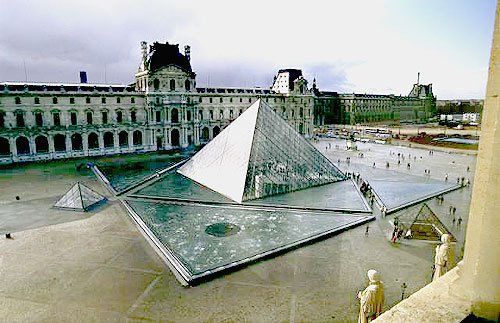
NOW, there is even more to the museum, largely because of a huge project launched in 1981 by then-French President François Mitterrand. The Grand Louvre, as it is called, put a modern glass pyramid designed by American architect Pei at the center of the classically French building ensemble; doubled exhibition space by opening the northern wing, formerly occupied by the French Finance Ministry; and gave the complex a subterranean shopping mall. When the $960-million Grand Louvre was first announced, the French protested. It was too expensive and ambitious. Critics scoffed at Pei's pyramid, and journalists dubbed Mitterrand "Ramses II" for the Pharaoh whose building lust is documented in the museum's Egyptian wing. But the complaints subsided when the Grand Louvre reached completion around 2000. With a new entrance in the middle of the Cour Napoléon, the museum seemed far more user-friendly and Pei's controversial pyramid became a beloved landmark.
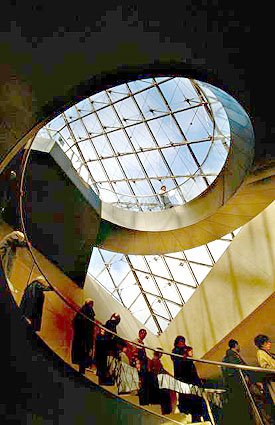
The staircase in the Pyramid

1 comment:

self hypnosis said...

Many people know the importance of self confidence and try to boost their own by using many different personal development models. Self confidence to most people is the ability to feel at ease in most situations but low self confidence in many areas may be due to a lack of self esteem. Low self esteem takes a more subtle form that low self confidence. So if you are tired of feeling not good enough, afraid of moving towards your desires and goals, feel that no matter what you do it is just never good enough, then your self esteem could do with a boost.

Every day we make decisions based on our level of self-esteem. We also exhibit that level of self esteem to those around us through our behaviour. 90% of all communication is non-verbal - it is not what you say but ho you say it that matters! Your body language, tonality and facial gestures can all tell a completely different story to your words. It is our behaviour which influences others and people react to us by reading our non-verbal communications. Have you ever met someone you just didn't like although on the surface they seemed polite and courteous, or you met someone who seemed to speak confidently yet you knew they were really frightened underneath and just displaying bravado?

Parental and peer influences play a major part in moulding our level of self-esteem when we are children and in our early years of adolescence. The opinions of the people closest to us and how they reacted to us as individuals or part of the group was a dominant factor in the processes involved in forming our self esteem.

As adults we tend to perpetuate these beliefs about ourselves and in the vast majority of cases they are ridiculously erroneous. It is time to re-evaluate our opinion of ourselves and come to some new conclusions about these old belief patterns.

Ask yourself some serious question:
Is your long-held view about yourself accurate? Do we respect the sources from which we derived these beliefs? Most of the negative feedback we bought into as we were growing up actually came from people we have little or no respect for and as adults we would probably laugh their comments away! Yet the damage to your self esteem was done when you were very young and you still carry it with you to this day.

Is it possible that even those people you respected, who influenced your self-worth, were wrong? Perhaps they had low self esteem also.

As adults we have the opportunity to reshape our self-esteem. Try to judge accurately the feedback you receive from people you respect. This process will allow you to deepen your understanding of yourself and expand your self-image. It will also show you were you actually need to change things about yourself and were you don't. Many people are striving to better themselves in areas where they are just fine or actually excelling and it is only because they have an inaccurate picture of themselves in their minds due to low self esteem!

Setting small goals and achieving them will greatly boost your self-esteem. Identify your real weakness and strengths and begin a training program to better your inter-personal or professional skills. This will support you in your future big life goals and boost your self-esteem and self confidence to high levels you didn't existed!

Learn to recognise what makes you feel good about yourself and do more of it. Everyone has certain things that they do which makes them feel worthwhile but people with low self esteem tend to belittle these feelings or ignore them.

Take inventory of all the things that you have already accomplished in your life no matter how small they may seem. Recognise that you have made achievements in your life and remember all the positive things that you have done for yourself and others. Take a note of your failures and don't make excuses like "I'm just not good enough" or "I just knew that would happen to me", analyse the situation and prepare yourself better for the next time. If someone else created success, regardless of the obstacles, then you are capable of doing the same! Remember everyone has different strengths and weakness so do not judge your own performance against that of another just use them as inspiration and know that what one human being has achieved so can another!

Surround yourself with people who respect you and want what is best for you - people who are honest about your strengths and will help you work through your weakness. Give the same level of support to them!

Avoid people who continually undermine you or make you feel small. These people are just displaying very low self esteem. As your own self esteem grows you will find that you are no longer intimidated by another's self confidence or success and you can actually be joyful for them! Do things you love to do and that make you happy. A truly happy person never has low self esteem they are too busy enjoying life! By getting busy living your life with passion and joy you will not be able to be self-consciousness.

If you find yourself feeling self-conscious in any situation focus on the fact that others can tell and many of them will be feeling the same. Be honest. People respond to someone better if they openly say "To tell you the truth I'm a bit nervous" rather than displaying bravo or fake confidence that they can see right through. Their reactions to you, will show your mind at a deep level, that there was actually nothing to be frightened of and everything is great. If someone reacts to this negatively they are just displaying low self esteem and very quickly you will find others noticing this! Really listen to people when they talk to you instead of running through all the negative things that could happen in your head or focusing on your lack of confidence. People respond to someone who is truly with them in the moment..

Breath deeply and slow down. Don't rush to do things.

Stop the negative talk! 'I'm no good at that' or "I couldn't possibly do that" are affirmations that support your lack of self esteem. Instead say "I have never done that before but I am willing to try" or "how best can I do that?". Which leads us to the last point - the quality of the questions you ask yourself s very important.
When you ask a question it almost always has a preposition in it. For example, "How did I mess that up?" presumes that something was messed up, a better way of phrasing the question would be "what way can I fix this quickly?", as this presumes you can and will fix it. Or "How am I ever going to reach my goal?" could be rephrased as "what way will lead me to my goal quicker" presumes that you are going to reach your goal! Get the picture? Change the quality of your questions and your results will change!

Practise these techniques and watch your self esteem rise day by day. personal development plan