Saturday, March 25, 2006

GARBO: THE SPY WHO WAS HONORED BY THE BRITISH . . . AND THE GERMANS


From Wikipedia, the free encyclopedia

Garbo was the British codename of Juan Pujol GarcĂ­a (February 14, 1912, Barcelona – October 10, 1988, Caracas), a double-agent who played a key role in the success of D-Day towards the end of World War II. The false information Pujol supplied to the German command helped persuade Hitler that the main attack would come later, resulting in his decision to hold back troops from the area around the D-Day landings.

Pujol was a Catalan who had developed a detestation of Nazi Germany after his experience of Fascism in Spain. He decided around 1940 that he must make a contribution to the war by helping Britain, Germany's only remaining adversary.

His wife made the first approach to the British but they showed no interest in employing him as a spy. So he resolved to establish himself as a German agent before approaching the British again to offer his services as a double-agent.

Operating initially in Lisbon, he pretended to the Germans that he was in Britain. He fabricated reports about shipping movements, successfully convincing them from information gleaned from the library in Lisbon and from newsreel reports he saw in cinemas. He claimed to be travelling around Britain and submitted his travel expenses based on fares listed in a British railway guide. A slight difficulty was that he did not understand the pre-decimal system of currency used in Britain, expressed in pounds, shillings and pence and was unable to add up the total. Instead he simply itemised the costs and said he would send the total later.

Eventually, he again made contact with British intelligence, and again offered his services. This time he was accepted.

Pujol reached Britain in the spring of 1942, and operated as a double agent under the aegis of the XX Committee. He pretended to have recruited a large network of agents, including a number of influential people with 'inside' information.

On occasions he had to fabricate reasons why his agents had failed to report easily available information that the Germans would eventually know about. For example, he reported that his (fabricated) Liverpool agent had fallen ill just before a major fleet movement from that port on the west coast of England. The illness meant that the agent was unable to warn the Germans of the event. To support the story of the illness, the "agent" eventually "died" and a notice was placed in the local newspaper as further evidence to convince the Germans, who were also persuaded to pay a pension to the agent's "widow".

The information supplied by Pujol to the Germans was orchestrated by his British handlers and included a certain amount of genuine events, in order to make the reports appear more convincing. Sometimes, this was achieved by sending genuine information but artificially delaying its arrival until the information would be harmless. For example, a letter might be postmarked with a date before some planned troop movements, but its delivery delayed until after the Germans would already have discovered the information for themselves. The Germans paid Garbo (or Arabel, as they called him) a large amount of money to support his network of agents, which at one point totalled 27 fabricated characters.

Garbo has the distinction of being one of the few people during World War II to receive decorations from both sides, gaining both an Iron Cross from the Germans and an MBE from the British.

Garbo's misinformation was part of Operation Fortitude, the effort that successfully convinced Adolf Hitler and many of the German high command to believe that the main Allied invasion was going to occur at the Pas de Calais, 150 miles east of Normandy, and that the Normandy landings were a feint designed to draw German forces away from the Pas de Calais.

After the war Pujol moved to Venezuela, where he lived in anonymity. He died in Caracas in 1988.

Saturday, March 18, 2006

MAN OF LA MANCHA: INSPIRATION THAT IS TIMELESS


To Each His Dulcinea (To Every Man His Dream)

To each his Dulcinea
That he alone can name...
To each a secret hiding place
Where he can find the haunting face
To light his secret flame.
For with his Dulcinea Beside him so to stand,
A man can do quite anything,
Outfly the bird upon the wing,
Hold moonlight in his hand.
Yet if you build your life on dreams
It's prudent to recall,
A man with moonlight in his hand
Has nothing there at all.
There is no Dulcinea,
She's made of flame and air,
And yet how lovely life would seem
If ev'ry man could weave a dream
To keep him from despair.
To each his Dulcinea...
Though she's naught but flame and air!

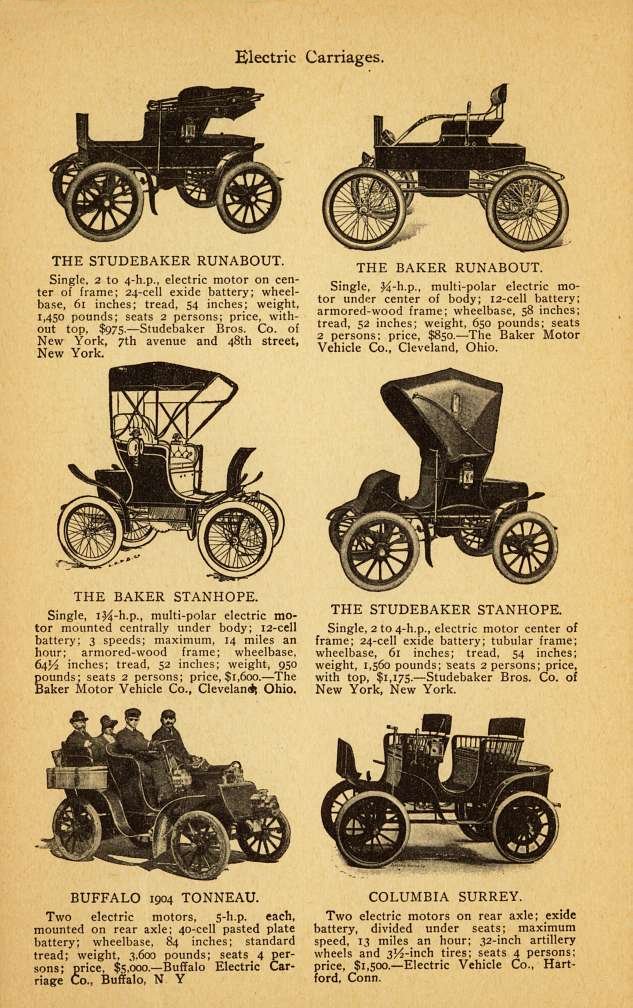
AUTOMOBILES OF 1904


TIMES PAST: MARCH 18, 1904

Ruling in Favor of Automobilists

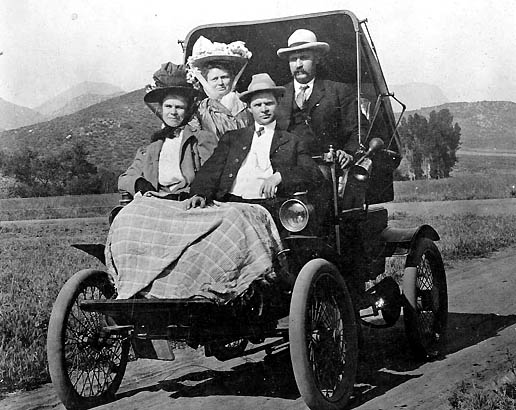
A Los Angeles judge dismissed a lawsuit brought by a woman who said an automobile passing her carriage caused her horse to shy and drop the load it was carrying. The woman, identified in The Times as Mrs. Walker, was seeking $15,000 (about $307,853 in 2005 dollars) from the driver and the man who lent him the Winton automobile, which passed her carriage on the road between Los Angeles and Rivera. But Superior Court Judge Frank F. Oster ruled that the car's driver was keeping to his own side of the road and that evidence showed the horse was skittish around automobiles. A story in The Times about the dismissal of the case ran under the headline: "In Favor of Automobilists" and said that drivers of cars were "congratulating themselves over what they consider the establishment of a valuable precedent in their favor." Shown below is another automobile of 1904: a 1904 Knoxmobile. >>

 Posted by Picasa

Wednesday, March 15, 2006

IT CAN HAPPEN EVEN IN L. A. . . . TORNADO LIFTS CARS, ROOFS AND PEOPLE


A tornado that reportedly originated near Rancho Palos Verdes tore the roofs off buildings and uprooted trees in Hawthorne, Lawndale and Lennox before heading, accompanied by fierce rain and hail, to wreak damage on factories in East Los Angeles. The Los Angeles Times said that for several minutes, "the air above Hawthorne was black with whirling tar paper." People reported being picked up and carried 50 feet to 75 feet by the twister, and others said it lifted cars off the ground. This frightening event took place on March 15, 1930. The images above and below depict the beauty and the horror of tornadoes.

Tuesday, March 14, 2006

POLICE ARREST 1400 FOR DEFYING KITE-FLYING BAN


Pakistani police arrested about 1400 people over three days to enforce a ban on kite flying imposed because of a series of fatal accidents. The government of Punjab province had imposed the ban during this year's Basant festival after kite strings reinforced with wire or glass fatally slashed seven people. Fliers often strengthen their strings before engaging in duels in which the object is to cut an opponent's string. Last year 19 people died on Basant day.
The image above shows an unusual kite, the "Peter Pan Boat Kite" . . . and, yes it really does fly.

Saturday, March 11, 2006

A PIAF INSPIRATION


Yes, I know I did an extensive posting on Edith Piaf awhile back, but she is such an inspiration for me, I couldn't resist. This is her signature piece, translated from the original French, and the emotional impact is universal.

NO REGRETS by Edith Piaff

No! No Regrets
No! I will have no regrets
All these things
That went wrong
For at last I have learned to be strong

No! No regrets
No! Let there be no regrets
Why explain?
Why delay?
Don’t go away
Simply call it a day

Fleeting moments we knew
I will set them apart
Every word, every sigh
Will be burned in my heart

But no tears will be shed
There’ll be no one to blame
Let it always be said
We attempted what came

No! No regrets
No! We will have no regrets
As you leave, I can say
Love was king
If for only a day

Life still goes on
Dare even though love has gone
One last kiss, shrug and sigh
No regrets, even though it’s goodbye

Sunday, March 05, 2006

Griffith Park's Unique Donor


 Posted by PicasaImagine a man who gives over 3,000 acres of land to his adopted hometown for a park, and then donates a fortune to build a popular observatory/planetarium/hall of science and a large open-air theater.

Imagine a man who enrages many of his peers with long years of insufferable pomposity and then shoots his well-regarded high-society wife in a paranoid delusion that she is in league with the Pope to poison him and steal his money.

Imagine if they were the same man.

You've just imagined one of the most unimaginable characters in the history of Los Angeles, Col. Griffith J. Griffith.

Famous for Giving Griffith Park to the City, Col. Griffith, who died on July 6, 1919, is mostly remembered as donor of 3015 acres that became the core of Griffith Park, and for donating money to build the park's Greek Theatre and Griffith Observatory. But the "colonel" was a complicated man. He had towering virtues and cavernous faults. Along with other big property holders, he made enormous profits from rampant, feverish land speculation that peaked in 1886-87. And, oh yes, he married into money as well. Christina Mesmer wasn't just rich, she was also dignified and respected. They remained married for 16 years. Then in 1903 things went tragically haywire. Although the colonel was richer and more powerful than ever, he was also terribly nervous and edgy, his wife later testified. He compulsively bit his nails, his manicurist said. And he was a sneak drinker, his lawyer said, privately putting away two quarts of whiskey a day while publicly aligning himself with the city's strong temperance movement.

In August the Griffiths went to the Arcadia Hotel in Santa Monica. Christina Griffith hoped a month in the Presidential Suite overlooking the palisades would help her husband unwind. But the colonel's strange behavior intensified. Waitresses said he switched his food and drink with his wife's. You never know if someone's trying to poison you, he told them. They chalked it up to a strange sense of humor.

But the last day of the Griffiths' vacation was about as unfunny as things get. Christina Griffith was addressing a few last postcards and beginning to gather her things. Her husband entered the room with a prayer book in one hand and a revolver in the other. Unfortunately, he handed her the prayer book.

She was on her knees when the colonel aimed and fired. Christina Griffith jerked her head at the last minute. That saved her life. She hurled herself out a window, landed on an awning below, and crawled to safety through another window. One author who attended Col. Griffith's trial called Christina Griffith "the society wife who wouldn't die."


Colonel Brought to Justice

The shooting left Christina Griffith disfigured and blind in one eye. Some observers say the colonel was lucky he wasn't lynched. His trial was spectacular and ghastly. Special prosecutors, led by an ex-governor, were called in. The defense was based around a novel idea: alcoholic insanity. Earl Rogers, the colonel's attorney, argued that heavy and steady consumption of alcohol had transformed religious friction in the Griffiths' marriage--he was Protestant, she was Catholic, and they were both devout--into weird murderous delusions. The defense worked. Col. Griffith was sentenced to two years in prison, with the stipulation that he be treated for his alcoholic insanity.

Whatever it was that snapped in the colonel in 1903 apparently snapped back while he was in prison. From his cell at San Quentin, he asked that he not be given any special treatment. He passed up an opportunity to work in the prison library; instead, he made burlap sacks in the jute mill alongside humbler prisoners. He refused parole as well. One of his few remaining friends, a judge, said the colonel wanted to pay his debt to society as fully as possible.


Colonel Rebuilds His Life

When he got out of prison, the colonel had little--other than the park land he had donated to the city in 1896--to tie him to Los Angeles. Most people around town still hated him and most of the others thought he was crazy. He was divorced. His only child was independent. And he was still rich.

But he returned to Los Angeles and stayed for the remaining 13 years of his life. Sources say he was quieter and less pompous. He lectured on prison reform, advocating rehabilitation over punishment. And he persistently worked at improving his park.

In 1912 he offered the city $100,000 to build a popular observatory atop Mt. Hollywood (Formerly Mt. Griffith, it had been renamed while he was in prison.). In his letter to the mayor and city council, the colonel waxed expansively about opening up the heavens to the common people, inspiring, educating and uplifting them. "Ambition," he wrote, "must have broad spaces and mighty distances."

If someone else had made the offer, the city might have jumped at it. But, as things stood, the city council jumped the other way, flatly refusing the money. Wrote one prominent citizen in a letter published on the front page of a local newspaper:

On behalf of the rising generation of girls and boys we protest against the acceptance of this bribe . . . This community is neither so poor nor so lost to sense of public decency that it can afford to accept this money.
The colonel, however, pressed on. In 1913 he offered $50,000 to build a Greek Theater. That project also ground to a standstill. At one point the Park Commission brought suit to force the colonel to stop preparations for construction. The colonel responded by setting up a trust fund to provide money for building the two facilities he had promised after he was gone.

Millions have enjoyed Griffith Park during the nearly 100 years since Col. Griffith donated it to the city. The Greek Theatre has stood for 65 years, the Observatory for 60.

Thursday, February 23, 2006

YESTERDAY AND TODAY . . .

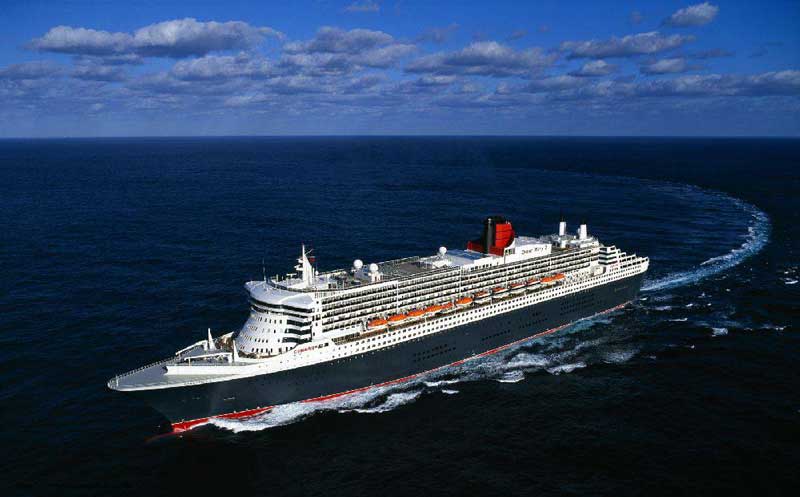
Thousands of people came out to view the massive 2-year-old Queen Mary 2, or QM2, after it arrived in Los Angeles on Wednesday for its first West Coast stop. Several hundred people were waiting in the dark along the Main Channel when the ship arrived at 4:45 a.m., said Los Angeles port spokeswoman Theresa Adams-Lopez. By 4:30 p.m., she said, 12,000 cars had been counted carrying onlookers hoping to catch a glimpse of the massive vessel.
The ship is so big that it had to back into its terminal because it could not fit under the Vincent Thomas Bridge. It spent the day docked double-wide, in Berths 91 and 92, and attracting so much attention that it caused traffic jams both on and around the bridge all day.

But it is today's meeting of the two Queen Marys that ocean liner aficionados have been waiting for.The old ship was among the grandest of its time; the new ship, loaded with every lavish modern amenity, is the world's largest and most expensive ocean liner.

The meeting brings into sharp relief the contrast between two eras: the heady years of the last century when opulent ocean liners ruled the Atlantic, and the efficient and plugged-in early 21st century, when hardly any American takes a ship to Europe, but quick cruises to the Caribbean or Mexico are popular.Most of those aboard the QM2 can relax outdoors in private, on the balconies connected to 80% of the staterooms and cabins. The balconies give the boat, viewed from the side, a little of the look of a massive waterfront hotel or condominium complex.

On the first Queen, passengers could send radiograms ashore in emergencies but remained for days on end largely isolated from the rest of the world. The ship published a daily newspaper to keep passengers vaguely abreast of world affairs. But the new ship offers constant updates from such cable news stations as CNN, viewable on the televisions in every cabin.

Those on the QM2 receive temporary ship e-mail addresses and can surf the Internet in their cabins, at 13 WiFi hotspots scattered around the boat and in an Internet cafe called ConneXions. Anyone can reach them any time, even their faraway bosses at work onshore. Passengers on the old Queen Mary kept in shape with frequent "constitutionals" on the wide teak decks, where they could inspect and greet fellow passengers and breathe in the sea air. The bathtubs on the old boat came with four spigots: fresh and salt water, hot and cold.

QM2 passengers enjoy ultramodern gyms and a Canyon Ranch spa, as well as countless opportunities to relax in style in such venues as a wine bar, a champagne bar and a casino. They can even go shopping in an onboard Hermes boutique.

But even with its 21st century trappings, the QM2 takes pride in its old-world stylishness. On Wednesday, a string quartet played Handel's "Water Music" as passengers came aboard. The inside also retains some of the aura of an old-time liner, with thick red carpeting, chandeliers, sweeping staircases and Art Deco metalwork.

And for all its high-tech extras, the new ship cruises at 28.5 knots, exactly the same speed of the old ship in the days when it used to steam across the Atlantic.

Meeting of the queens

Queen Mary 2 was docked at the Port of Los Angeles this week, directly west of the vintage Queen Mary in Long Beach. It was the first time the two elegant ocean liners were in the same area. Here's a look at the two ships:


Queen Mary
1,019 feet

Capacity: 2,139 passengers

Number of decks: 12

Gross tonnage: 81,237 tons

Propulsion: Steam turbines

Horsepower: 160,000

Cruising speed: 28.5 knots (34 mph)

Maiden voyage: May 27-June 1, 1936, from Southampton, England, to New York

Final cruise: Oct. 31-Dec. 9, 1967, from Southampton to Long Beach

Sample voyage: Minimum round-trip ocean fare per person for New York/England Atlantic crossing, summer 1936: first-class cabin $536, second class $276, third class $167.50

Typical stateroom: First class, two twin beds, sitting area, private bath, portholes; third class, bunkbeds, sink, bath down the hall

Menu selection: July 12, 1936: duckling, guinea chicken, quail, jumbo squab, cauliflower hollandaise, Prince of Wales pudding, chocolate eclairs, French pastry, fried Camembert


Queen Mary 2
1,132 feet

Capacity: 2,620 passengers

Number of decks: 17

Gross tonnage: 151,400 tons

Propulsion: Diesel-electric / gas turbines

Horsepower: 157,000

Cruising speed: 28.5 knots (34 mph)

Maiden voyage: Jan. 12, 2004, from Southampton, England, to Ft. Lauderdale, Fla.

Sample voyage: 36-day South American voyage from Los Angeles, per person double occupancy fares from $7,749 to $79,349

Typical stateroom: Interactive televisions, walk-in closets, direct-dial phones, individual thermostats, full baths with tubs and/or showers

Menu selection: Feb. 22, 2006, Britannia English restaurant: prosciutto with arugula coulis, shrimp thermador, oxtail consomme, lobster risotto, Oriental glazed Alaskan salmon, gingered greens and citrus soy emulsion, slow-roasted pork, caramelized creme brulee, cappuccino souffle


Sunday, February 19, 2006

LONDON HAS FOUND AN ICON TO RESHAPE IT"S IMAGE

A skyline is a city's signature. But it takes a bold stroke to change a bland collection of buildings that could be anywhere, into an instantly recognizable icon. London, dominated for centuries by St. Paul's Dome and Tower Bridge has recently changed the landscape with the addition of 30 St. Mary Axe to its autograph. Named after its address, Londoners have nicknamed it "The Gherkin" for its unique shape. And now the Gherkin is rapidly overtaking Big Ben as the simalcrum of choice. It's the first new high-rise office building erected in the city since Tower 42 in 1980.

Here we see London's altered skyline with the Gherkin.

Tuesday, February 14, 2006

AMERICAN SPEEDSKATER WINS MEN'S 500-METER RACE, THEN SAYS HE WILL DONATE HIS $25,000 USOC BONUS TO CHARITY

TURIN, Italy — Gold was on his mind. What good would a gold medal do, after all, when the applause died down?

So, two days before his race, Joey Cheek had coffee with Johann Olav Koss in the Olympic village, an American speedskater and his Norwegian inspiration. Koss won four gold medals in speedskating, then devoted his life to the children of the world.

Cheek did not ask Koss how to win the race. He asked how he could help others if he did.

"He was talking that he wanted to do something big," Koss said. "I was so humbled to meet such a person. The most important race of his life is coming up in a couple days, and he's talking about what he can do to give back."

Cheek did that, within minutes after he'd won the men's 500-meter race Monday. He announced that he would donate $25,000 so that children in African refugee camps might have a chance to play sports.

"For me to walk away with a gold medal is amazing," Cheek said, "and the best way to say thanks that I can think of is to help somebody else."

The $25,000 represents the prize awarded by the U.S. Olympic Committee to all gold medalists. Cheek donated his to Right to Play, the organization led by Koss that provides recreation programs to underprivileged children in 20 countries across Africa, Asia and the Middle East.

Friday, February 10, 2006

THE SKY IS FALLING IN ALASKA

HOMER, Alaska — It is, in the world of volcanoes, one of the little guys — a bump on the sea, a molehill among mountains. Some days, Mt. Augustine barely peeks above the mist that settles across Cook Inlet in south central Alaska.

Residents of this fishing town 70 miles to the east have been keeping an eye on the volcano, which woke up Jan. 11 and dusted the inlet with ash. The mountain has been erupting intermittently ever since. It is the focus of attention for the region and the talk of the town for Homer, the nearest community of any size.

Concerns began last month at two community meetings where state and federal emergency managers laid out the scenario for an Augustine-caused tsunami. The probability was low, they said, but damage to Homer — if it happened — could be catastrophic

Thursday, February 09, 2006

STEVE FOSSETT'S VIEW OF THE WORLD FROM ABOVE THE CLOUDS

Adventurer Steve Fossett set out from Kennedy Space Center in Cape Canaveral, Florida on his quest to break the record for the world's longest aircraft flight in his Virgin Atlantic Global Flyer. The takeoff on the runway normally used by space shuttles when they return to Earth was free of technical problems, but the plane struck two seabirds. "Takeoff was a bit scary to say the least," said Fossett, 61, who's goal is to complete a nearly 27,000-mile trip once around the world and then across the Atlantic again, with a landing Saturday outside London. The 80-hour voyage would break the airplane distance record of 24,987 miles set in 1986 by the lightweight Voyager aircraft piloted by Dick Rutan and Jeanna Yeager.

UPDATE: February 12, 2006 --- MANSTON, England — Fighting through sleep deprivation, severe turbulence and a last-gasp emergency landing, Steve Fossett broke the record for the longest nonstop flight in aviation history.

The 61-year-old adventurer piloted his lightweight experimental plane, Virgin Atlantic GlobalFlyer, to set a record of 26,389 miles in about 76 hours despite a complete electronic failure that threatened to turn his return into a nightmare.

Fossett began emergency landing procedures when a generator light started to flash upon his descent.

The mechanical crisis forced him to land Saturday at Bournemouth International Airport in southern England, instead of at his planned landing point in nearby Kent, where hundreds of well-wishers were gathered.

"He burst two tires on landing, and the poor GlobalFlyer had to be dragged off the runway," said Steve Ridgway, chief executive of Virgin Atlantic, the company sponsoring Fossett's record bid.

Ground control confirmed that Fossett had broken the distance record of 24,987 miles as his plane flew over Shannon, Ireland, after crossing the Atlantic, his ground team said.

That eclipsed the 1986 record set by the Voyager aircraft, piloted by Dick Rutan and Jeana Yeager. It also beat the balloon record of 25,361 miles set in 1999 by the Breitling Orbiter 3.

Fossett arrived at Kent International Airport on a private jet alongside Richard Branson, the Virgin Atlantic owner. Fossett was greeted by his wife, Peggy, and applause.

He spoke from the tarmac of his delight and relief at completing the flight.

Fossett said he realized he was in trouble when he began his descent for Kent and a light came on indicating the plane's generator had failed.

"I was really lucky to make it here today; there was a lot going on. The tension of the final part really took it out of me, but I will be fine in the morning," he told reporters.

The finale was one of several episodes that nearly doomed his 3 1/2 -day voyage.

During takeoff Wednesday from Kennedy Space Center in Florida, his plane lost about 750 pounds of fuel in a leak — and he nearly ran out of runway.

"I had to pull up with all my might" to get the plane in the air before the end of the airstrip, he said.

Severe turbulence over India "almost broke the plane apart," he said, forcing him to strap on a parachute.

After the news conference he was presented with the Guinness World Record for the longest flight in history.

Wednesday, February 08, 2006

How could this happen in America ?? It doesn't seem possible, but it did.


On this day in 1915, filmmaker D.W. Griffith's Civil War epic "The Clansman" opened at Clune's Auditorium on the northeast corner of 5th and Olive streets in Los Angeles, with 17 police officers guarding the entrance as 3,000 people jammed into high-priced $2 seats. As part of an advertising ploy, actors in full Ku Klux Klan regalia sat on horseback outside the theater. They were surrounded by shouting African American protesters. "The Clansman," which glorified the Ku Klux Klan and included many demeaning images of black people, opened only after Griffith got a court injunction. The local censors had approved the film, but City Council members had voted to suppress it because of its racist content. Scenes were cut and the film was retitled "The Birth of a Nation" before it opened in New York the following month. The photo above is of a 1922 Ku Klux Klan rally in the South.

Tuesday, February 07, 2006

YOU WERE MY FAVORITE LOVE . . . THOSE WERE MY FAVORITE YEARS

You, reappearing in my mind
You were right & I was blind
But that was long ago
Now, do I ever cross your mind
Are your memories like mine
OR have they let you go
After all the loves I've lived through
All these years
I had to go so far without you
Now it's clear
You were my favorite love
That was my favorite year


When we, we were young forever yesterday
Fools and little children run away
If we could go back there, would we stay?
After all the loves I've lived through
All these years
I had to go so far without you
Now it's clear
You were my favorite love
That was my favorite year

IT WAS BOUND TO HAPPEN SOONER OR LATER . . .

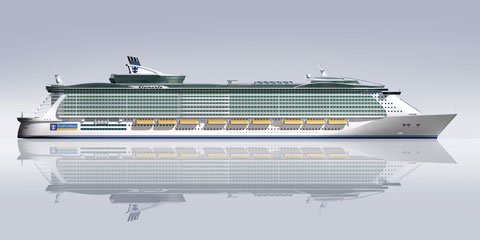
Royal Caribbean orders biggest, priciest cruise ship ever


Royal Caribbean International has ordered a cruise ship that is 45 per cent bigger than any passenger liner now afloat and costs more than any commercial vessel in history. The ship will be 360 metres long, carry up to 6,400 passengers and cost $1 billion US to build, plus another $240 million US to equip and furnish, "from forks and knives and sheets, to artwork and everything else," a company executive said.


The new vessel, pictured above, will be 45% bigger than the Queen Mary 2, currently the world's largest cruise ship. The ship, dubbed Project Genesis, will measure 220,000 gross registered tons – the standard measure for a vessel's size.

Cunard Line's Queen Mary 2 (shown below), at 151,400 gross registered tons, is the world's largest cruise ship. Royal Caribbean is scheduled to get the 160,000-ton Freedom of the Seas in June.

Project Genesis will be built by Norway's Aker Yards ASA of Oslo, Europe's largest shipbuilder. Aker Yards said the contract price of $1 billion US (900 million euros) makes it "the most valuable ship ever ordered in the history of commercial shipbuilding." Aker Yards said the contract is contingent on final approval of financing, with delivery scheduled for the fall of 2009.

"It is exhilarating to take such a giant step into the future," Royal Caribbean CEO Richard Fain said. "Its bold design, daring innovations and technological advancements will delight our existing cruisers and help us draw in new ones."

The company said plans for onboard amenities aren't yet finalized, but its previous innovations have included ice rinks, rock climbing walls and surfing pools.

Monday, February 06, 2006

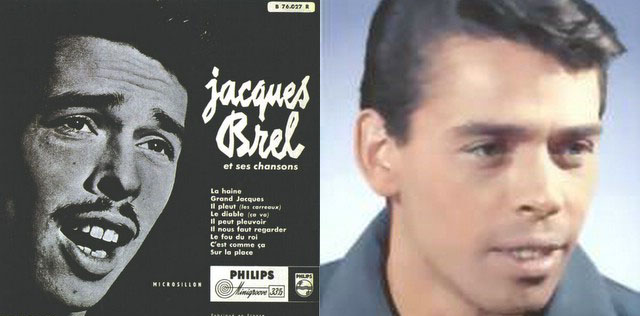
JACQUES BREL IS ALIVE AND WELL IN MY MIND

Some prople think that Jacques Brel was the biggest singer-songwriter of all times. A wonderful human being : a loner, a brilliant storyteller, an excellent singer, a very good actor. Born in the year 1929 in a well-off family in Schaarbeek, Brussels. In between his studies (Saint-Louis), his military service (in Limburg), a marriage, kids and work in a cardboard factory he confined his poetry to paper

For Brel, the words to the music were more important than the music itself : "He wanted to get a message across. Not paying attention to the lyrics, you lose Brel. His heroes and anti-heroes come from life itself. Above all, he uses his personal experience, he projects his dreams. He is haunted by the effect of time on the body, the disgrace and the physical degradation. For the women in his songs, the breasts are often portrayed as lowering. For the men and for himself, Brel fears aging more than death itself."

The legacy of Brel : some 100 songs, the appearances in his films, the International Brel foundation, films of his live-performances at the Olympia in Paris and the Ancienne Belgique in Brussels that send shivers down your spine.

Brel surely is one of the most covered artists around. Among the interpreters of his music are the likes of Scott Walker, Alex Harvey, Neil Diamond, Ray Charles, Frank Sinatra, Petula Clark, Shirley Bassey, David Bowie, Nina Simone, Mark Almond, Arno, Leonard Cohen ...

His talent also widely surpasses the areas of the world where French is spoken : In America for example, Terry Jacks scored a number 1 hit with an adaptation of Le Moribond (Seasons in the sun) and even to this day a "libretto-less" musical tours the country : "Jacques Brel is Alive and Well and Living in Paris".

Here's a story that illustrates Brel's impact. As jazz-performer Mike Zwerin recalled : "my friend ... called me and asked if I wanted to go to Carnegie Hall with him that night to hear 'some Frenchman named Brel' sing. Neither one of us had ever heard of him or understood one word of French, but free tickets are free tickets. We were surprised to find the hall packed. We were even more astonished when we heard Mr. Brel. Though jazz musicians are known for their hostility to singers in general - considering them a commercial necessity taking away time from more talented instrumentalists - we were overwhelmed. Transfixed. Brel's language was universal and the intensity of the performance overflowed the boundary of such a limiting definition as 'singer'."

Now 20 years after his death, almost nothing of the impact of Jacques Brel has been lost. Some simple analogies could give you an impression of the power of Brel : "as poetic as Bob Dylan, as introspective as John Lennon, as virile as Bruce Springsteen; his intense stage presence, and the killing involvement it reflected, was reminiscent of Edith Piaf."

Sunday, February 05, 2006

Sondheim told us in song and verse about Being Alive

Someone to hold you too close,
Someone to hurt you too deep,
Someone to sit in your chair,
To ruin your sleep.

Someone to need you too much,
Someone to know you too well,
Someone to pull you up short
And put you through hell.

Someone you have to let in,
Someone whose feelings you spare,
Someone who, like it or not,
Will want you to share
A little, a lot.

Someone to crowd you with love,
Someone to force you to care,
Someone to make you come through,
Who'll always be there,
As frightened as you
Of being alive,
Being alive,

Somebody, hold me too close,
Somebody, hurt me too deep,
Somebody, sit in my chair
And ruin my sleep
And make me aware
Of being alive,
Being alive.

Somebody, need me too much,
Somebody, know me too well,
Somebody, pull me up short
And put me through hell
And give me support
For being alive,
Make me alive.

Make me confused,
Mock me with praise,
Let me be used,
Vary my days.
But alone is alone, not alive.

Somebody, crowd me with love,
Somebody, force me to care,
Somebody, make me come through,
I'll always be there,
As frightened as you,
To help us survive
Being alive,
Being alive,
Being alive!

From Stephen Sondheim's Broadway show COMPANY