Sunday, May 14, 2006

THE MYSTERY OF THE LOUVRE: A PARIS MASTERPIECE

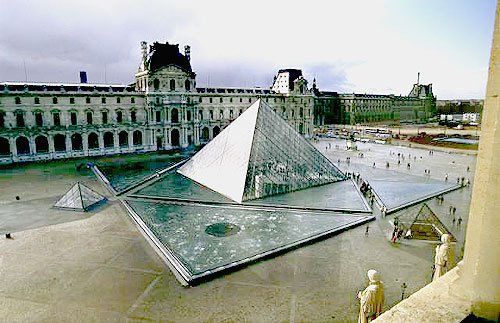
WHEN "The Da Vinci Code" opens Friday in the U.S., one of the first places moviegoers will see is the Louvre, where the story starts. Director Ron Howard was allowed to film in the museum, so moviegoers will see the real thing: architect I.M. Pei's Pyramid, the 1,450-foot Grande Galerie and the Salle des États where Leonardo da Vinci's "Mona Lisa" hangs. For some viewers, scenes shot there will fly by, but lovers of the Louvre may pause between handfuls of popcorn to admire the museum in the heart of Paris that saw record-breaking numbers of visitors last year.

Since the filming there last spring, the museum has distanced itself from the movie, reflecting the French art establishment's well-known scorn for popular culture and the Louvre's weariness with the phenomenon created by "The Da Vinci Code," Dan Brown's controversial 2003 mystery about the supposed secret history of Christianity. Officials at the museum aren't publicly linking the dramatic increase in visitation — from about 6 million in 2000 to 7.5 million last year — with the novel, even though 57 million copies of the book are in print in 44 languages.

After all, the Louvre is not a movie set. It is a world-famous art gallery and museum of mankind in the surpassingly beautiful abode of French kings, like London's National Gallery, British Museum and Buckingham Palace all rolled into one. The Louvre has been standing alongside the Seine for more than 800 years, first as a medieval fortress built around 1190 by crusading king Philippe Auguste (Philip II) and then as a rambling royal palace on which a long chain of French artists and architects put their marks. The kings of France were insatiable collectors, so when the palace opened as a museum in 1793, the treasure-trove became the property of the French people.

After the French Revolution, art kept rolling in, acquired through donations, pilferage during the Napoleonic Wars, field work by French archeologists and a now-defunct law that allowed curators to bargain-shop in customs-office basements for artwork barred from exportation. The Louvre has 300,000 works of art spanning almost 9,000 years of human civilization, including 52 Rubens, 12 Rembrandts and, thanks to the connoisseurship of Francis I in the 16th century, more Da Vincis than Italy (or anyplace else). "The Louvre is the book in which we learn to reach," French painter Paul Cézanne wrote in a 1905 letter.

The museum today

NOW, there is even more to the museum, largely because of a huge project launched in 1981 by then-French President François Mitterrand. The Grand Louvre, as it is called, put a modern glass pyramid designed by American architect Pei at the center of the classically French building ensemble; doubled exhibition space by opening the northern wing, formerly occupied by the French Finance Ministry; and gave the complex a subterranean shopping mall. When the $960-million Grand Louvre was first announced, the French protested. It was too expensive and ambitious. Critics scoffed at Pei's pyramid, and journalists dubbed Mitterrand "Ramses II" for the Pharaoh whose building lust is documented in the museum's Egyptian wing. But the complaints subsided when the Grand Louvre reached completion around 2000. With a new entrance in the middle of the Cour Napoléon, the museum seemed far more user-friendly and Pei's controversial pyramid became a beloved landmark.
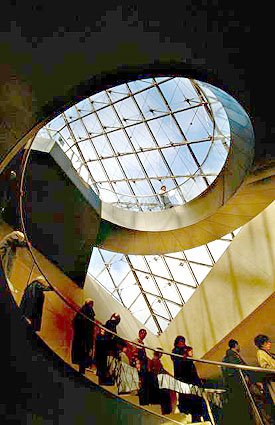
The staircase in the Pyramid
Saturday, May 13, 2006

Wednesday, May 10, 2006

ALMOST 100 YEARS AGO ON THIS DAY A PIONEER AVIATOR MADE HISTORY BY FLYING TO CATALINA

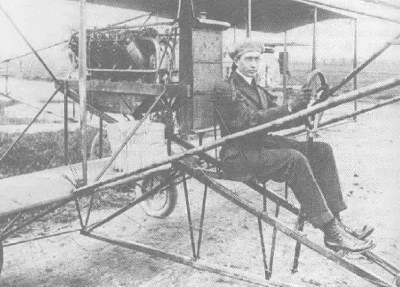
May 10, 1912: Southern California aviation pioneer Glenn Luther Martin made history when he flew his "hydro-aeroplane" over the ocean from "the waters of Newport Bay to the shore of Avalon, Catalina Island," The Times reported, under the headline "Most Daring Exhibition Ever Given By Birdman." Martin flew the 33 miles in his Avalon Zipper, the longest flight yet made over water, The Times said.
"He landed amid the tooting of horns and the shouts of a multitude of people whom he surprised by swooping down from the clouds," the newspaper reported. On his return flight he carried the day's mail from Catalina — another first. Glenn Luther Martin (1886-1955) began his impressive aviation career in Santa Ana, CA. In the photo above Martin is shown making an aerial delivery of the Fresno Republican newspaper in 1909.
Monday, May 08, 2006

Lillian Asplund, 99; Last U.S. Survivor of Titanic's Sinking

Lillian Gertrud Asplund, the last American survivor of the sinking of the Titanic in 1912, has died. She was 99. She was just 5 when she lost her father and three brothers — including her fraternal twin — when the luxury liner hailed as "practically unsinkable" went down. Her mother, Selma, and another brother, Felix, who was 3, survived the Titanic's sinking off Newfoundland in the early morning of April 15, 1912. Asplund was the last Titanic survivor with actual memories of the event, but she shunned publicity and rarely spoke about the tragedy in the North Atlantic. Among the more than 700 who survived, the two who are still alive were too young to remember the disaster. Barbara Dainton and Eliza Millvena Dean, both of England, were less than a year old when the jewel of the White Star Line struck an iceberg.

More than 1,500 people died on the maiden voyage of the ocean liner whose sinking has long gripped the public's imagination. That is partly because many prominent and wealthy passengers were on board, including Benjamin Guggenheim, who sipped brandy and smoked cigars with his valet while the ship went down. Mainly, it is because its owners had arrogantly trumpeted the ship, billed as a technological marvel, as "unsinkable." In the end, the vaunted network of watertight compartments had not been built high enough.

The Asplund family had boarded the Titanic in Southampton, England, as third-class passengers. They were on their way back to Worcester from their ancestral homeland, Sweden, where they had spent several years. After the ship struck the iceberg, the family went to the ship's upper deck, Asplund's mother recalled in an interview with the Worcester Telegram & Gazette shortly after returning to Massachusetts. "I could see the icebergs for a great distance around," she said. "It was cold and the little ones were cuddling close to one another and trying to keep from under the feet of the many excited people…. My little girl, Lillie, accompanied me, and my husband said, 'Go ahead, we will get into one of the other boats.' He smiled as he said it."
Rescued by the steamship Carpathia, the surviving Asplunds were taken to a New York City hospital before returning to Worcester to live with Selma Asplund's sister. Because the family lost all of its possessions and life savings of $700 on the Titanic, the city of Worcester held a fundraiser and benefit that brought in about $2,000 for them. In 1951, the family moved to Shrewsbury. Asplund never married. She worked at various secretarial jobs. She retired early to care for her mother, who was said to have never recovered from the tragedy. Selma Asplund was about 90 when she died on the 52nd anniversary of the sinking in 1964. Felix Asplund died in 1983 at 73.

Sunday, May 07, 2006

Was one of History's Greatest Villains really one of its Greatest Heroes ??

Will we ever know ??

"You know how to add, don't you ??" . . . . . A dark night, a mysterious dame and a gumshoe looking for clues in the case of the vanishing wages

I Was working late in my D.C. office. I'd been running some new simulations on my macro-model, but nothing was converging, so I figured I'd close up my spreadsheet and find a corner in some dark speak-easy to lick my wounds.

That's when she walked in. She had a neckline as low as the Nasdaq in '01, curves like sine waves and a dress tighter than the global oil supply. She had my attention even before she pulled out two reports I'd seen that very morning.

"I'm sorry to barge in on you like this," she said in a voice that gave my calculator a power surge. "I didn't know where else to turn."

"You came to the right place, doll," I said. "I see you've got the first-quarter GDP report, along with the new compensation results." I'd been puzzling over these numbers all day, but what, I wondered, could this tall glass of ice water want with them?

"That's right," she purred. "I need to know why GDP is up 4.8%, the strongest quarter since 2003, yet real wages are falling." Yeah, I thought, you and everybody else who works for a living.

"Why the interest?" I shot back. She didn't look like a Democrat.

"I wish I could tell you. But I work for some powerful people" — now I knew she wasn't a Democrat — "and they'd be very upset if they even knew I was here."

"Why me? Why don't you ask your powerful friends to explain why the economy's racing ahead but leaving working stiffs behind?"

She got kinda sulky, and I kinda liked it. "They wouldn't know where to look. What's worse, most of them think it's great when wage growth decelerates because with no inflationary pressure from labor costs, it means the Fed can take a powder on rate increases."

"Tell me about it, sister. I've been leaning on Bernanke for months on that point, but he doesn't return my calls."

Needless to say, I took the case. I wasn't sure what game little Miss Conflicting Reports was playing, but I figured I'd play along for now.

Fact is, I'd been asking the same question myself. Every quarter we seemed to be getting great news on top-line statistics — GDP, productivity, profits — yet the typical workers' real earnings were down 2% over the recovery. Guys like me don't like it when things line up that way.

I headed for the union hall, figuring some of those guys might have an angle. Problem was, with private-sector unions down to 8% of the workforce, the hall had become a Starbucks. I got a vanilla chai latte to go and beat it.

I decided to head for the new economy, so I looked up some managers and professionals in the service sector. I found them, all right, but they didn't have any answers. As of the first quarter of 2006, their compensation had lagged inflation for three quarters running.

This was more serious than I'd thought. Whatever was driving a wedge between overall growth and living standards, it was reaching pretty high up the pay scale. I wasn't sure what mess I'd gotten into here, but it was time to confront the doll that got me into it.

I caught up with her in her penthouse, a place that had "housing bubble" written all over it. I know my wealth distributions, and this kitten came from the top 0.1%. I don't like playing the sap — it was time for some class warfare.

"OK, gorgeous. Drop the 'two Americas' line and give it to me straight. You know as well as I do where the growth is going. What's your game?"

She nibbled her lip and looked up at me real sweet. "I suppose if I told you I'm just a girl who cares about the bottom 99%, you wouldn't believe me."

She supposed right.

"All right, I'll come clean," she said, slumping in a chaise lounge that probably cost the average income of the bottom fifth. "I work for the Republican National Committee, and we're starting to get spooked by the president's poll numbers on the economy. We figured if we don't get a little trickle-down soon, it could hurt us in 2006, not to mention '08."

I kicked myself for not seeing it sooner. "So you don't give a damn about the structural factors driving the productivity/wage gap: the declining unions, low minimum wage, the profit squeeze, slack job creation and, most of all, the way globalization is sapping the bargaining clout of the American worker, blue and white collar alike."

"Why should I?" she said, finally showing her true colors. "Any intervention would just cuff the invisible hand, doing more harm than good." She was Milton Friedman with the body of Scarlett Johansson. I had to get outta there.

"You're wrong," I shouted, staggering toward the door. "You can't see it, but these two reports are a microcosm of everything that's right and wrong with this economy. Tell your people that whoever understands and articulates this disconnect, along with a convincing policy agenda to reconnect growth and living standards — that's who wins the big tamale."

I was wasting my breath. She had me bounced by a security guard as pumped-up as ExxonMobil's profits.

I brushed off the dust and headed for the office. You'd think a case like this would be dispiriting to a guy like me, but you'd be wrong. Sure, she made me mad, but I saw things clearly now, and her little scheme was about to backfire.

There's an electorate out there that's looking for some economic stewardship. Maybe I'm just one economist in this big, crazy city, and maybe the other guys got the deep pockets. But the way I see it, we can shape our economic outcomes so that everyone gets a fair shake, not just the chosen few. I opened up a spreadsheet and got to work.
(written by Jared Bernstein, a senior economist at the Economic Policy Institute)

Saturday, May 06, 2006

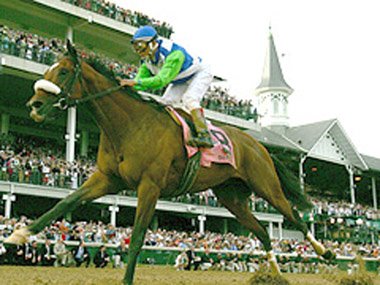
1,000 WORDS ARE EXPRESSED BY THE IMAGE BELOW

LOUISVILLE, Ky. (AP) -- Undefeated Barbaro stormed into the lead at the top of the stretch Saturday and won the Kentucky Derby convincingly for a trainer hailed as a hero 17 years ago. Michael Matz led three children to safety after United flight 232 from Denver to Chicago crashed into an Iowa cornfield. Now, nearly two decades later, the two brothers and their sister were in the grandstand at Churchill Downs cheering the strapping bay colt onto his sixth consecutive win.

Given a masterful ride by Edgar Prado, Barbaro delivered a smashing 6 1-2 length victory in beating a full field of 20 3-year-olds -- considered one of the toughest in years. With Sinister Minister and Keyed Entry setting the pace, Barbaro settled in right behind and made his move around the far turn, just as he had in winning his first five races. The Florida Derby winner, making his first start in five weeks, had plenty left in the tank to hold off Bluegrass Cat. Steppenwolfer was third, and there was a dead heat for fourth between Brother Derek and Jazil.

Barbaro becomes the sixth undefeated winner, following Smarty Jones in 2004.

Friday, May 05, 2006

"Call us crazy; you'd be right"

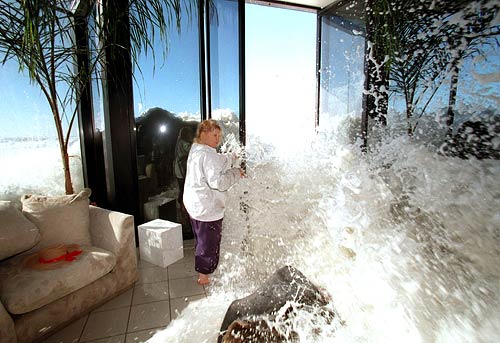
In January 1998, waves as high as 20 feet battered local beaches in California. North of Ventura, this Solimar Beach home was attacked by the huge waves.

Thursday, May 04, 2006

MAKING THE URBAN LIFE EXQUISITE

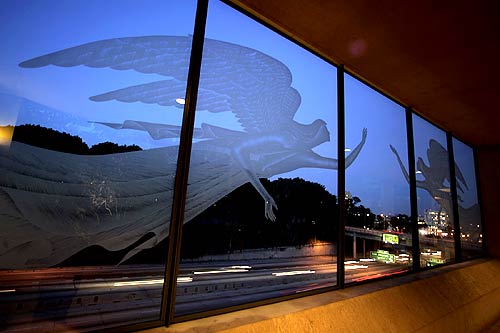
Spanish architect Jose Rafael Moneo used a wall of glass etched with angels as a boundary line between the grand Cathedral of Our Lady of the Angels and the humming Hollywood Freeway below in Los Angeles.

Monday, May 01, 2006

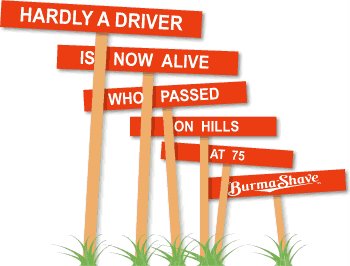
REMEMBER THE OLD BURMA SHAVE SIGNS ?? I POSTED SOME AWHILE BACK AND HERE'S SOME MORE


How many of these Grand Old Burma Shave Road Signs can you remember ??

TRAINS DON'T WANDER
ALL OVER THE MAP
'CAUSE NOBODY SITS
IN THE ENGINEER'S LAP
Burma Shave


SHE KISSED THE HAIRBRUSH
BY MISTAKE
SHE THOUGHT IT WAS
HER HUSBAND JAKE
Burma Shave

For those who never saw any of the Burma Shave signs,

here is a quick lesson in our history of the1930's and '40's.

Before there were interstates, when everyone drove the old 2 lane roads,

Burma Shave signs would be posted all over the countryside in farmers' fields.

They were small red signs with white letters.

Five signs,

about 100 feet apart,

each containing 1 line of a 4 line couplet......

and the obligatory 5th sign advertising Burma Shave, a popular shaving cream.

Here are more of the actual signs:

DON'T LOSE YOUR HEAD
TO GAIN A MINUTE
YOU NEED YOUR HEAD
YOUR BRAINS ARE IN IT
Burma Shave


DROVE TOO LONG
DRIVER SNOOZING
WHAT HAPPENED
NEXT IS NOT AMUSING
Burma Shave


BROTHER SPEEDER
LET'S REHEARSE
ALL TOGETHER
GOOD MORNING, NURSE
Burma Shave

CAUTIOUS RIDER
TO HER RECKLESS DEAR
LET'S HAVE LESS BULL
AND MORE STEER
Burma Shave

SPEED WAS HIGH
WEATHER WAS NOT
TIRES WERE THIN
X MARKS THE SPOT
Burma Shave

THE MIDNIGHT RIDE
OF PAUL FOR BEER
LED TO A WARMER
HEMISPHERE
Burma Shave

AROUND THE CURVE
LICKETY-SPLIT
BEAUTIFUL CAR
WASN'T IT?
Burma Shave

NO MATTER THE PRICE
NO MATTER HOW NEW
THE BEST SAFETY DEVICE
IN THE CAR IS YOU
Burma Shave

A GUY WHO DRIVES
A CAR WIDE OPEN
IS NOT THINKIN'
HE'S JUST HOPIN'
Burma Shave

AT INTERSECTIONS
LOOK EACH WAY
A HARP SOUNDS NICE
BUT IT'S HARD TO PLAY
Burma Shave

BOTH HANDS ON THE WHEEL
EYES ON THE ROAD
THAT'S THE SKILLFUL
DRIVER'S CODE
Burma Shave

THE ONE WHO DRIVES
WHEN HE'S BEEN DRINKING
DEPENDS ON YOU
TO DO HIS THINKING
Burma Shave

CAR IN DITCH
DRIVER IN TREE
THE MOON WAS FULL
AND SO WAS HE.
Burma Shave

And my all time favorite:
PASSING SCHOOL ZONE
TAKE IT SLOW
LET OUR LITTLE
SHAVERS GROW
Burma Shave

Do these bring back any old memories?
If not, you're merely a child.
If they do - then you're old as dirt...
LIKE ME!

THE STAR STILL SMOLDERS

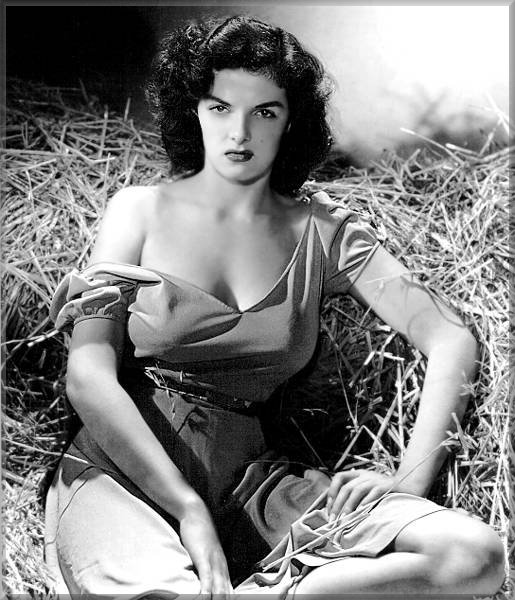
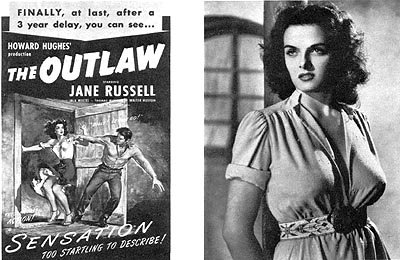
Jane Russell, a heartthrob of major proportions in her heyday and a trouper today, takes the stage again at 84, singing the songs of the '40s. It's five minutes to show time in Santa Maria, California. Jane Russell gingerly folds her glasses and sips her Sprite. At 84, she needs a little help up the single step to the tiny stage in the darkened hotel bar. Her eyes aren't what they used to be — she has macular degeneration — and she wears hearing aids in both ears. But the still-statuesque silver-haired woman decked out in a turquoise gown and heavy shell jewelry is unmistakably the brassy, sassy Jane Russell of yesteryear, the buxom bombshell whose pinup image defined the concept of longing for millions of GIs in World War II. In the right light, her imperious gaze still can smolder.
In 1999, after her third husband died, Russell moved from a Montecito mansion to a standard-issue subdivision in Santa Maria, home to her youngest son and his family. "When I moved up here, there wasn't a lot for seniors to do," she said. "And we were all so sick of today's music." Like a troupe of eager youngsters working to pay off Pa's mortgage in a 1940s movie, Russell and a couple of pals decided to put on a show. They work the first and third Fridays of the month at the Radisson Hotel, although Russell has just taken a travel leave that will last into the fall.

There was a time when she headlined with the likes of Frank Sinatra and Marilyn Monroe and Clark Gable. Now she performs with a local choir director, a lay preacher, a retired police officer and half a dozen others, many in their 70s and 80s. Most in the audiences at the Radisson are older folks as well. The revue — called "The Swinging Forties" — runs from about 6 to 9:30 p.m. so they can get home early. "Nine-thirty!" Russell said, freshening her tangerine lipstick. "Can you believe it?" When she made her name in show business, such early hours would have been out of the question. .

For five years, sizzling still photos of Russell paved the way for the release of her first film, 1943's "The Outlaw." Until then, thanks to sultry shots of Russell reclining on a haystack with a come-hither look and a gun, she was the most famous star in the U.S. not yet to have appeared in a movie. Eventually, she became known in films like "Gentlemen Prefer Blondes" for a having quick wit in addition to a voluptuous body.

But it was the body that moved men to grand gestures, like the troops in Korea who named two embattled hills in her honor. Even the censors were given to lyricism, including the Maryland judge who ruefully noted that in one film, Russell's breasts "hung over the picture like a summer thunderstorm spread out over a landscape."

Deeply religious both then and now, she looks back with regret at the unrelenting publicity over her bounteous figure. "Hollywood gook," said Russell, who later sided publicly with an industry panel that urged the removal of provocative scenes from one of her films. "It was nauseating." (The above comments are excerpts from today's Los Angeles Times) Hang in there, Jane---we'll always love you and you'll always be beautiful.

Thursday, April 27, 2006

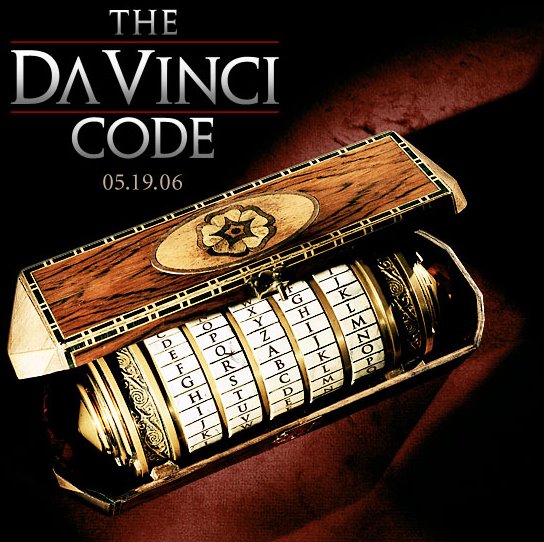
THE MYSTERY DEEPENS WITH THE DA VINCI CODE

The judge who presided over the Da Vinci Code trial has put a code of his own into his judgment and today said he would "probably" confirm it to the person who breaks it. Since Judge Peter Smith delivered his judgment in the case on April 7, lawyers in London and New York began noticing odd italicisations in the 71 page document.

In the weeks afterward, would be codebreakers got to work on deciphering the judge's code. "I can't discuss the judgment," Smith said in a brief conversation with The Associated Press, "but I don't see why a judgement should not be a matter of fun." Italics are placed in strange spots: the first is found in paragraph one of the 360 paragraph document. The letter S in the word claimants is italicised.

In the next graph, claimant is spelled "claiMant," and so on. The italicised letters in the first seven paragraphs spell out "Smithy code," playing on the judge's name. Lawyer Dan Tench, with the London firm Olswang, said he noticed the code when he spotted the striking italicised script in an online copy of the judgment.

"To encrypt a message in this manner, in a High Court judgment no less? It's out there," Tench said. "I think he was getting into the spirit of the thing. It doesn't take away from the validity of the judgment. He was just having a bit of fun."

Smith was arguably the highlight of the trial, with his acerbic questions and witty observations making the sometimes dry testimony more lively. Though today Smith refused to discuss the judgment or acknowledge outright that he'd inserted a secret code in its pages he said: "They don't look like typos, do they?"

When asked if someone would break the code, Smith said: "I don't know. It's not a difficult thing to do." And when asked if he would confirm a correct guess to an aspiring code-breaker, the High Court judge said, "probably".

Tench said the judge teasingly remarked that the code is a mixture of the italicised font code found in the book The Holy Blood and the Holy Grail - whose authors were suing Dan Brown's publisher, Random House, for copyright infringement - and the code found in Brown's The Da Vinci Code. Authors Michael Baigent and Richard Leigh had sued Random House Inc, claiming Brown's best-selling novel "appropriated the architecture" of their 1982 nonfiction book, The Holy Blood and the Holy Grail. Both books explore theories that Jesus married Mary Magdalene, the couple had a child and the bloodline survives, ideas dismissed by most historians and theologians.

The Da Vinci Code has sold more than 40 million copies since its release in March 2003. It came out in paperback in the United States last week, and quickly sold more than 500,000 copies. An initial print run of five million has already been raised to six million. Since the judgment was handed down three weeks ago, Tench said it took several weeks - and several watchful eyes - to spot the code. Now, London and New York attorneys are scrambling to decode the judgment. "I think it has caught the particular imagination of Americans," Tench said. "To have a British, staid High Court judge encrypt a judgment in this manner, it's jolly fun."

I'm definitely going to try to break the code," said attorney Mark Stephens, when learning of its existence. "Judges have been known to write very sophisticated and amusing judgments," Stephens said. "This trend started long ago ... one did a judgment in rhyme. Another in couplets. There has been precedent for this. "It adds a bit of fun to what might have been a dusty text," he said.
UPDATE: Code cracked in 'Da Vinci' case (April 29, 2006) The British judge who embedded an encoded message in his recent judgment in a case involving Dan Brown's bestseller "The Da Vinci Code" revealed the secret after a London lawyer solved the puzzle.

In his ruling, Justice Peter Smith hid a reference to the man who invented the British Navy's first modern warship, using the Fibonacci Sequence, a combination of a mathematical progression and letter substitutions featured in Brown's religious thriller. Dan Tench, a lawyer at the law firm Olswang, claims he was first to uncover it: "Jackie Fisher who are you Dreadnought." John "Jackie" Fisher was a 19th-century admiral credited with developing the Dreadnought, a battleship equipped with six or more guns.

TIMELESS BEAUTY THAT RESONATES WITH HOMEY ELEGANCE AND STYLE

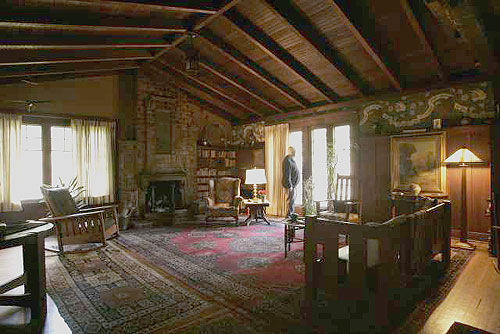
For decades, historian Robert Winter has preserved a 1909 bungalow in Pasadena that resonates with timeless beauty. For the last 34 years, Winter has owned the Batchelders' former home and been guardian of the legacy that lives inside, preserving the 1909 Craftsman on the east side of the Arroyo Seco as a homage to the legendary artisan who built it. To comprehend the timelessness of Batchelder — his willingness to "play down excess," Winter says — one only need step into Winter's living room, where the tiled fireplace emanates warmth, richness and a lived-in elegance. "It doesn't call attention to itself," the historian says, "that is, except to say that it's beautiful." Batchelder's business failed during the Great Depression, and the artist died in 1957. But his designs — often depicting ships, castles and nature scenes in a spare, matte finish — remain coveted by collectors and grace Arts and Crafts homes built in the early 20th century, many considered historic simply by virtue of their Batchelder fireplaces.

Wednesday, April 26, 2006

DID YOU SEE IT ?? THE GREATEST ILLUMINATION FEAT IN THE HISTORY OF THE WEST.

The motion picture industry orchestrated an extravaganza to dedicate Los Angeles' new City Hall. Film producer Joseph Schenck was master of ceremonies, Sid Grauman ran the entertainment and Cecil B. DeMille arranged part of the celebratory parade, which, according to The Times, stretched over five miles and included a lion in a cage.

That night, the city experienced "the greatest illumination feat in the history of the West, when the entire lighting equipment of the Metro-Goldwyn-Mayer film studios illuminated it for its dedication," The Times reported. Irving Berlin sang at the ceremonies. From the White House, President Calvin Coolidge pressed a telegraph key to light the Charles Lindbergh Beacon atop City Hall's pyramidal tower. It all happened on April 26, 1928 and I'm sorry I missed it.

Tuesday, April 25, 2006

YES, THIS WOULD HAVE TO QUALIFY AS ANOTHER BIT OF INFORMATION THAT YOU'LL PROBABLY NEVER NEED

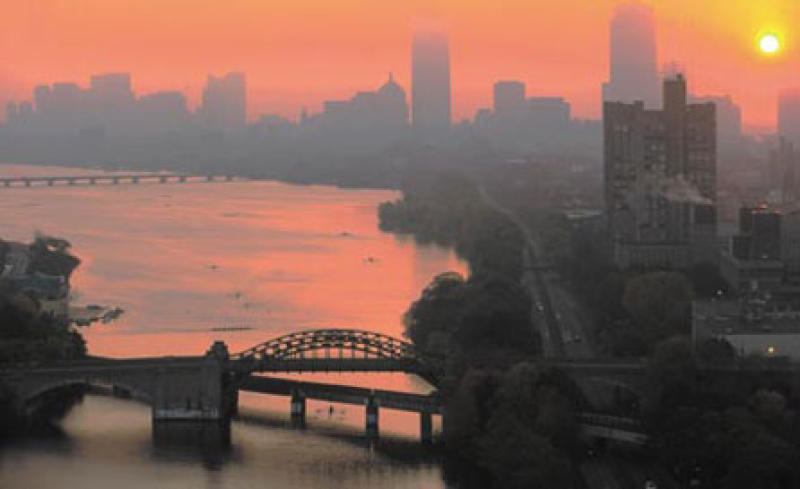
The Boston University Bridge is one of the few places in the world where a boat can sail under a train driving under a car driving under an airplane.
The Boston University Bridge at sunset.

WHAT DO YOU SEE HERE ??

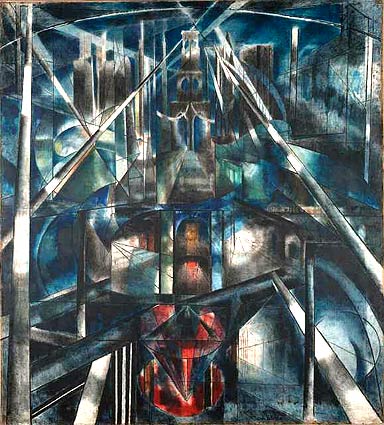
MODERNISM: “Brooklyn Bridge” (1919-20) was painted by Joseph Stella, one of the American artists whose work was pulled into a collection that also included the most avant of Europe’s avant-garde.

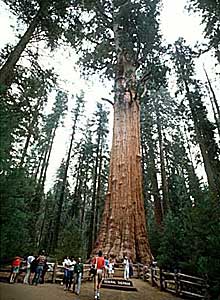
GIANT SEQUOIA TREE IS THE LARGEST LIVING TREE ON EARTH

The General Sherman Tree in California's Sequoia National Park is thought to be the world’s largest by volume, an estimated 52,508 cubic feet. Its weight is about equal to that of 10 blue whales, and it has one branch nearly 7 feet in diameter.

Sunday, April 23, 2006

THE BEAUTY OF CALIFORNIA IS TRULY INSPIRING

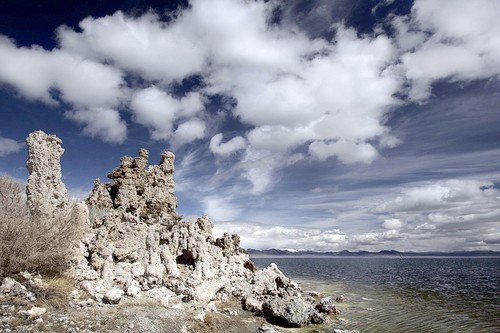
U.S. 395 takes travelers on a tour through desert and mountains, past ghost towns and motels, serene lakes and alpine ski resorts. In the image above, misty late-afternoon light hovers over the snow-covered eastern Sierra which form a spectacular backdrop to the pastoral scene below. The image below is of Mono Lake where exposed limestone tufa towers are created by freshwater springs that bubble up through the lake, which is twice as salty as the ocean.

Thursday, April 20, 2006

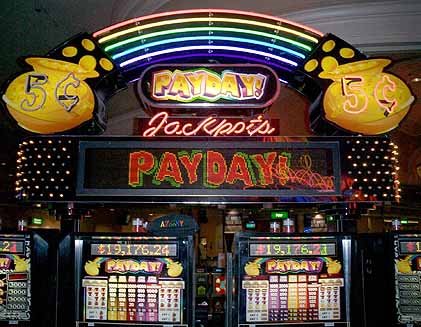
TEN MILLION DOLLARS WON ON A NICKEL SLOT MACHINE !!!

For 84-year-old Josephine Crawford, the golden years just got a lot more golden. After plunking $40 into slot machines in an Atlantic City casino, the retired waitress hit a $10-million jackpot on a nickel progressive machine. "Somehow, I'll spend it," she said. I'll bet she will.

Wednesday, April 19, 2006

HERE TODAY . . . GONE TOMORROW

NORTH KINGSTOWN, R.I. --Since the Jamestown Bridge first opened, Rhode Islanders have alternately embraced it as an enduring landmark or loathed its narrow lanes and car-shaking winds that always seemed worse on the see-through grating high above Narragansett Bay.
Smoke rises as the old Jamestown Bridge falls 135 feet into the waters of Narragansett Bay today in North Kingstown, R.I. The landmark bridge, built in 1940, connected North Kingstown and Jamestown. The steel center span of 1100 feet, which rose 240 feet, was dropped into the bay using 75 pounds of explosives. Before the Jamestown Bridge opened, Conanicut Island's only link to the rest of the state was an unreliable ferry system that often did not run in bad weather. Traffic is now routed across the nearby Jamestown-Verrazano Bridge, which was closed for the demolition.(AP Photo)

Tuesday, April 18, 2006

IT'S A NEW DAY WITH CIRQUE DE SOLEIL


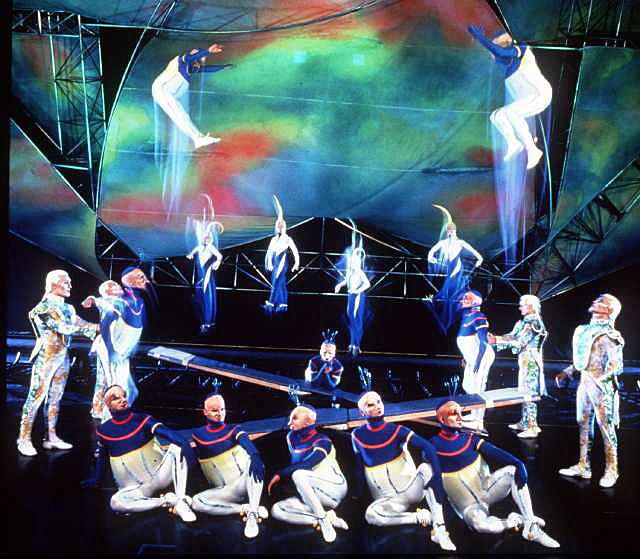
Looking back, the Cirque de Soleil show,"Mystere" which opened in December 1993 was probably the most significant event in Las Vegas entertainment since the arrival of Elvis Presley as a regular headliner. The template for the successful contemporary Las Vegas high end resort (mixing clubs, fine dining, shopping and entertainment on equal footing with gambling) is generally believed to have started with the Mirage in 1989. But for its headliner, the property took an already well established act, "Siegfried & Roy," and built them a custom showroom. Obviously, that decision worked out brilliantly for Mirage but ducked the issue of how to move Las Vegas into more innovative entertainment than variety acts, topless showgirls and established headliners.
So, when next door to the Mirage, Treasure Island opened "Mystere" a few years later the time was more than ripe for something new, and instantly shows like "Splash" and "Jubliee!" become retro-Vegas. "Mystere" was Cirque's first free standing show (other Cirque shows toured North America) and this allowed the troupe unprecedented opportunities to innovate and create (staging, lighting and the unlimited potential of a custom theatre) that resulted in what is still thought to be the best of the French Canadian company's efforts in town.
After "Mystere"'s success Cirque became the most important entertainment creators in Las Vegas by becoming the go to team for MGM-Mirage properties. They now have four shows going. Anyway, the amazing thing is that "Mystere" is now more than a decade old and the production still seems fresh. And, yet because of its age, "Mystere" is the one Cirque show tourists even have a chance at getting things like ticket bargains and good last minute seats. Good deal.
In the most simplistic terms "O" (at Bellagio) is "Mystere" on water, "Zumanity" (at New York New York) is "Mystere" with pumped up overt sexuality, and "KA" (at MGM Grand) is "Mystere" built into a Hollywood blockbuster with magnificent and epic staging and scope. Each of the Cirque shows is really, really good in its own way. Still, if you can only see one of these shows, "Mystere" is the most integrated theatre work.
So, now back to the Mirage where, after the Siegfried & Roy show closed, the decision what to do next was now an entirely predictable one: Cirque. So, Cirque has show number five, as yet untitled (rumor is that the name of the new show will be Love), based on the music of the Beatles coming to the Mirage in late June or early July. This will be within weeks of when "Phantom of The Opera" opens at the Venetian. Interestingly this will put this latest installment of the Cirque empire into a head to head competition for attention with the latest chapter in the Broadway/Vegas nexus. Stay tuned. (The comments above, are excerpts from the Movable Buffet blogger).

What's 41 feet long, weighs 15,000 pounds, travels in packs and wouldn't mind a bite of your tri-tip sandwich ??

Could be your relatives from Wisconsin, but in this case we're talking about Mapusaurus roseae, perhaps the largest meat-eating dinosaur ever. Paleontologists say they've found fossilized remains of the beasts in Argentina. What they don't know is why the dinosaurs died.

Sunday, April 16, 2006

"WRONG WAY" PILOT FLIES OFF COURSE, INTO HISTORY

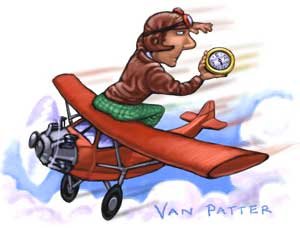
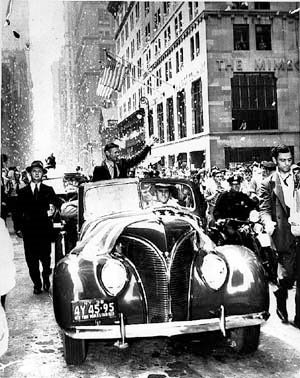
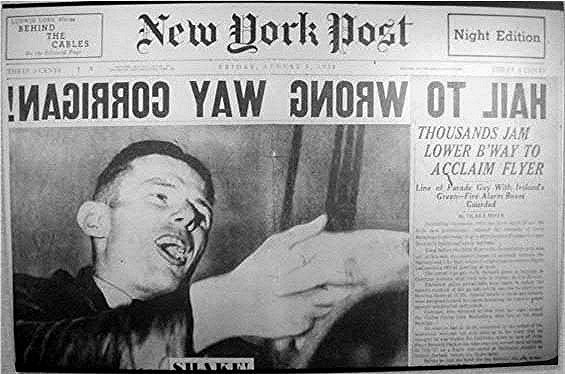
Douglas "Wrong Way" Corrigan blamed it on the clouds and a faulty compass. That's how he wound up in Ireland on his way to California, he insisted. Never mind that he'd sought permission for a transatlantic flight and twice been denied. Aviation authorities said his rickety craft would never make it across the ocean. Despite a cockpit door "latched" with wire and extra fuel tanks obscuring his vision, he landed safely near Dublin. But really, Corrigan maintained from 1938 until he died in 1995, he intended to fly from New York to Los Angeles that day.
"I made a mistake," he said.His feat caught the fancy of a world in the grip of prewar tension and the Depression. People chose to believe it was Corrigan's way of thumbing his nose at authority.
Wrong Way Corrigan riding in this parade honoring him.

Thursday, April 13, 2006

THE PALM RESTAURANT IN WEST HOLLYWOOD OPENED IN 1975---NOW THEY'RE CLOSING THEIR DOORS AND TAKING THEIR WALLS WITH THEM WHEN THEY RELOCATE

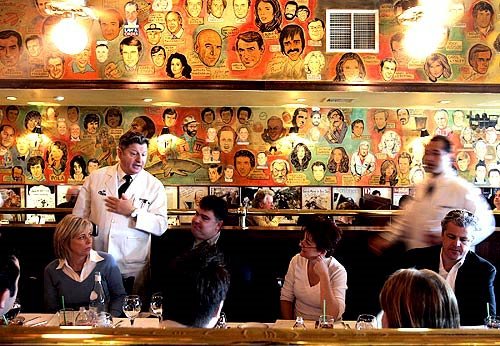
A table of L.A's elite listen attentively at the Palm Restaurant in West Hollywood to their server's suggestions while surrounded by caricatures drawn onto the walls for the past thirty years.

The mythology of the place can be traced to the East Side of Manhattan, where two Italian immigrants opened the original Palm restaurant in 1926. The story goes that without the money to decorate their fledgling steakhouse, partners Pio Bozzi and John Ganzi traded repasts of chops and pasta for drawings on the wall by local artists and cartoonists. The restaurant became a fixture in New York, up there with Sardi's and the 21 Club.

Monday, April 10, 2006

IN LIFE, IT'S ALL ABOUT HOW YOU LAND

"We lived in the wind and sand with our eyes on the stars" --- Women Airforce Service Pilots ---
WASP Pilot Violet Thurn Cowden

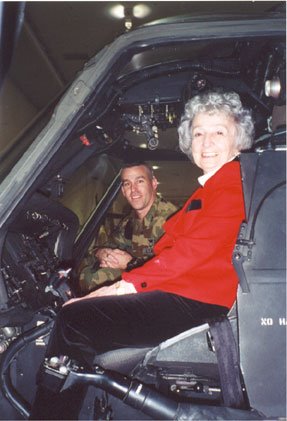
How big do you have to be to fly a P-51? Obviously, at least 5'2' and 100 pounds! In addition to the P-51, Pilot Vi Cowden also flew the P-39, P-40, P-47, and P-63 during World War II. The WASP were the first women military pilots to serve the United States Army Air Force during World War II. Almost 25,000 women applied to the WASP and 1830 were accepted.

They flew wartime missions within the United States. The WASP flew more than 60 million miles in 78 different types of military aircraft - from trainers to B-29 bombers. At the time, women could not be commissioned pilots in the military and were governed by the Civil Service Commission. Thirty-eight women lost their lives and were not covered by government life insurance.

In 1979, the Secretary of the Air Force granted that long overdue recognition and veteran status to the WASP.

Vi Cowden's latest parachuting adventure came Feb. 25, when she dived with the Golden Knights, the Army's elite parachute team. With a team member behind her firmly attached by harness, Cowden plummeted through the sky for about 30 seconds. Smiling ear to ear, she spread her arms out like wings as the wind blew furiously against her face. Once the divers' parachute was released, they floated the rest of 12,500-foot drop. Her husband, 85, admitted he was "a little bit concerned" for her safety but enjoyed watching her. "It's beautiful floating down like a bird," he said.

Saturday, April 08, 2006

ANOTHER INDIVIDUAL WHO MADE A DIFFERENCE . . . A BIG DIFFERENCE

Dr. Charles Schepens, a World War II hero who helped more than 100 people escape from Nazi-occupied France and a noted ophthalmologist widely considered the father of modern retinal surgery, died March 28 of a massive stroke at his home in Nahant, Mass.

He was 94 and had received the French Legion of Honor from the consul general of France only a few days before his death. His exploits during the war were a secret known only to his family and a few others until the 2004 publication of the book "The Surgeon and the Shepherd" brought them to a wider audience, including French officials.

Born in Belgium, Schepens (pronounced SKAY-pens) had already earned his medical degree when, in the early stages of the war, he joined the Belgian air force. After its defeat, he returned to private medical practice.

He was arrested by the Gestapo in October 1940 on trumped-up charges of using a bus to transport Allied pilots out of Belgium. Although he was released 10 days later, the experience turned the previously apolitical physician into an activist, and he allowed his office to be used as a post office for underground agents, arranging for the transfer of maps and such information as troop movements.

In 1942, a spy in Gestapo headquarters alerted him that he was about to be arrested again, and he escaped to Paris, where he adopted the name Jacques Perot-Spengler, later shortened to Jacques Perot.

Looking over a Michelin map to find an escape route to Spain, he and a group of fellow resistors spied an abandoned sawmill near the town of Mendive in the Pyrenees on the Spanish border. One of the key features was a 12-mile cable car system extending up the mountain and terminating near the border.

Schepens, a rugged outdoorsman, bought the mill in July 1942 with backing from a wealthy French patriot and had it in full operation by the end of the year. The site became a functioning lumber enterprise, taking orders, delivering wood and meeting a payroll.

But men performing manual labor around the mill could surreptitiously ride the cable car system to the top of the mountain and slip into Spain, often with the assistance of a shepherd named Jean Sarochar. Sarochar died in 1975.

More than 100 Allied pilots, POWs, Belgian government officials and others made their way out of France over the cable railway. The system was also used to move documents, currency, propaganda and other materials into and out of France.

Schepens kept his profile low and cooperated with the Nazis to divert suspicion — so much so that many locals considered him a collaborator. But in July 1943, the Nazis captured a member of the Resistance who told them about Schepens' activities.

When the Gestapo showed up, he later recounted, he told them he would return to Paris to confront his accuser. Then he said, " 'You know, it is now 10 o'clock. I have 150 workers idle, because they have not been given their orders this morning. Give me 10 minutes with them. I'll give the orders and come back.' So I walked out and escaped."

He spent 16 days in the forest before reaching Spain and, eventually, England, where he resumed his medical career.

His wife and children were placed under house arrest by the Nazis, who hoped to use them to lure Schepens back. But they made their own daring escape, hiking through the mountains to reach Spain, and were reunited with Schepens in England nine months after he fled.

Back at work, the doctor began testing a theory he had developed as a medical student that retinal surgery could be performed more precisely if the surgeon used both eyes rather than looking through a monocular microscope.

He tested the theory by building a device known as the indirect binocular ophthalmoscope, piecing it together from bits of metal retrieved from his London hospital after a V-1 bomb attack. The device, which sits on the surgeon's head and leaves his hands free, is now used by surgeons worldwide and is a major reason that the success rate for reattachment of retinas has improved from 40% to more than 90%.

Schepens immigrated to the United States in 1947 and started the retina service at the Massachusetts Eye and Ear Infirmary, part of Harvard Medical School. Three years later, he established what is now the Schepens Eye Research Institute, the largest independent institute for ophthalmology research in the world.

Over the course of his career, which continued well past his retirement from Harvard in 1978, he wrote four books and published more than 360 research papers. Up to the time of his death, he was commuting to Boston three days a week to see patients.

Charles L. Schepens was born in Mouscron, Belgium, in 1912, the son of a general practitioner. The youngest of six children, he had three brothers who also became physicians. After his father died when he was 7, he was raised by one of the brothers.

Schepens studied mathematics in college before taking up the family business of medicine. But the interest in math led to his subsequent interest in ophthalmologic instrumentation. In addition to the ophthalmoscope, he developed a variety of other instruments, including micro-scissors for surgery on the vitreous, the clear gel in the middle of the eye.

According to his family, Schepens was always athletic, with a lifelong interest in woodcutting, swimming and walking.

Had it not been for the intervention of the Nazis, he might have stayed in France in the lumber business, he said.

"It was a wonderful life, you know," he told the Boston Globe in 2004.

Schepens is survived by his wife of 69 years, Marie Germaine, known as Cette; a son, Luc, of Southborough, Mass.; three daughters, Bernadette Butler of Nahant, Catherine Rojas of Petaluma, Calif., and Claire Delori of Brussels; eight grandchildren; and four great-grandchildren.

Friday, April 07, 2006

CASABLANCA TOPS THEM ALL WITH BEST SCREENPLAY

Hollywood screenwriters should know a good movie script when they see one, and "Casablanca" has been crowned the best screenplay ever.

The members of the Writers Guild of America voted Julius J. Epstein, Philip G. Epstein and Howard Koch's "Casablanca" into the top spot of the guild's 101 greatest screenplays.

In a tally announced Thursday, Francis Ford Coppola's collaborations with Mario Puzo on the first two "Godfather" scripts were both voted into the top 10 — although "Godfather III" somehow didn't make the cut.

Among living screenwriters, Woody Allen tied with Coppola (who also was honored for his work on "Patton" and "Apocalypse Now") for the most mentions with four: "Hannah and Her Sisters" (No. 95), "Crimes and Misdemeanors" (No. 57), "Manhattan" (No. 54) and "Annie Hall" (No. 6).

Charlie Kaufman ("Adaptation," "Being John Malkovich" and "Eternal Sunshine of the Spotless Mind") and William Goldman ("Butch Cassidy and the Sundance Kid," "All the President's Men" and "The Princess Bride") each earned three recognitions.

Neither the script for "Crash" nor "Brokeback Mountain," which won this year's WGA and Academy Award screenplay awards, landed on the list.

The guild, which has branches on both coasts and 9,500 film and television writer members, voted its top 10 screenplays in this order:

1. "Casablanca"
2. "The Godfather"
3. "Chinatown"
4. "Citizen Kane"
5. "All About Eve"
6. "Annie Hall"
7. "Sunset Boulevard"8. "Network"
9. "Some Like It Hot"
10. "The Godfather II"

It's a little surprising to me that Casablanca's screenplay was selected #1. There probably are better screenplays but not better movies. It's the total package that makes Casablanca the best movie ever made. Drama that is riveting, romance that tears at your heart and unforgettable characterizations that take on a life of their own are some of the elements that make Casablanca great. The magnetism of Humphrey Bogart and Ingrid Bergman is magical and compelling. Add to that the humor that is so preposterous but works so well, and then of course you have that song: Is there anyone, anywhere in the world who doesn't know the song, "As Time Goes By" ?? Many of us know the lines from many parts of the movie. One of my favorite scenes is where one of Rick's girls pleads with him, "Where were you last night?" and he answers, "That's so long ago, I don't remember." Then she says, "Will I see you tonight?" and he answers, "I never make plans that far ahead." My recollections of Casablanca make me laugh long after the film has ended.

Wednesday, April 05, 2006

A MIRACLE: NO ONE WAS KILLED

An engine malfunction apparently caused this C-5B Galaxy cargo plane, the military's largest, to crash shortly after takeoff from Dover Air Force Base in Delaware. All 17 people aboard survived though several were drenched with fuel and 14 were taken to the hospital.

Tuesday, April 04, 2006

A MAGICAL PERFORMANCE THAT WILL PLEASE YOUR EAR, ENRICH YOUR LIFE AND LIVE IN YOUR HEART


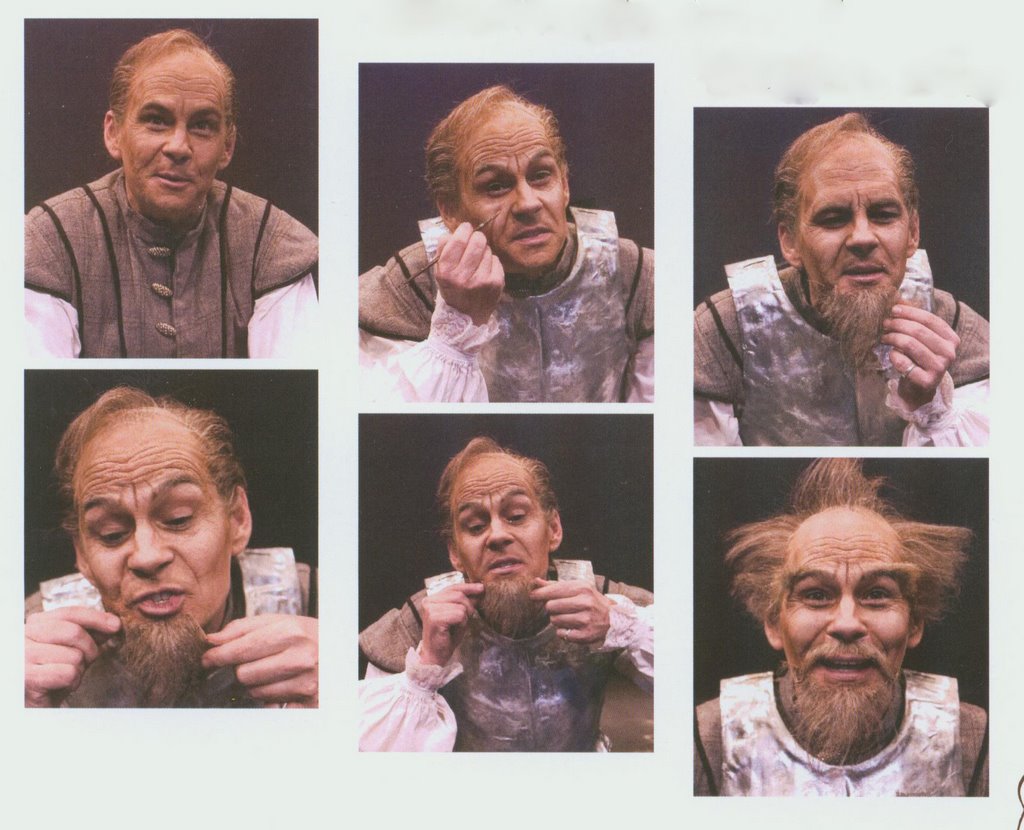
El Camino's MAN OF LA MANCHA is a glorious production starring George Champion as the knight errant who chases windmills and protects the honor of wenches. Bets Danko plays Aldonza and John Massey is Sancho. This is powerful theatre that uses hopes and dreams to vanquish despair. Critics have described George Champion's performance as riveting and flawless. His rendition of "The Impossible Dream" brought chills to the audience and left them awe-struck.
The transformation of Miguel de Cervantes into Don Quixote takes place on stage before your very eyes.
George Champion and John Massey

Sunday, April 02, 2006

EIGHT-SIDED ENIGMA, CASTEL DEL MONTE IN ITALY'S BOOT, LURES VISITORS INTO THE MYSTERY OF ITS MAKER


AT Castel del Monte, the stage is set for tragedy or black magic. Clouds scuttle across the sky, and a milk-white full moon rises. Footsteps echo on cold, wheat-colored stone, startling pigeons into flight.

A medieval emperor hunted with falcons and cheetahs here, consulted astrologers and slept on Oriental silk. Local people sought refuge during the plague, and brigands hid out in the castle. Vandals over the years stripped it, leaving little more than an empty shell on a lonely hilltop at the edge of the Murge, a barren-looking limestone plateau worlds apart from the sunny Italian south most people know.

This medieval masterpiece, begun in 1240 — about the same time as Westminster Abbey — has eight sides, linked by eight eight-sided towers. Its seemingly endless repetition of the octagonal form has haunted mathematicians through the ages who see it as a work of pure geometry. The more mystically inclined impute occult significance to this temple of the octagon, noting that great buildings around the world, such as Jerusalem's 1,300-year-old Dome of the Rock, also have eight sides.

Whether icon or equation, the castle has more vibes than "The Da Vinci Code." But Castel del Monte, as silent as a sarcophagus and as strange as a UFO, keeps its secrets, glowing like the crown of its 13th century builder, Holy Roman Emperor Frederick II.

Like England's Richard the Lion-Hearted and saintly Louis IX of France, Frederick was one of the giants of the European Middle Ages, though far more complex than his contemporaries. Cultured and brutal, despotic and enlightened, a Christian crusader who was excommunicated, he left a legacy that historians still debate, including David Abulafia, author of the recent biography "Frederick II: A Medieval Emperor," which seeks to demystify the medieval ruler.

But Frederick's enigmatic aura has proved hard to dislodge. In his time and afterward, he was called stupor mundi (the wonder of the world) and the Antichrist. A 1927 biography of Frederick by German historian Ernst Kantorowicz was a favorite of Hitler, whose delusions of grandeur were fueled partly by the emperor's efforts to consolidate a realm that included Germany, the Netherlands, Austria, Poland, parts of France and Italy, Malta, Cyprus, Israel and Lebanon.

Of all the lands he ruled, he loved low-lying Puglia best, in those days a richly forested region bordered on the east by the Adriatic Sea. Here he built his startling octagonal castle, part hunting lodge, part pleasure palace, part symbol of his might.

Among great architectural ciphers, Castel del Monte stands out for its stubborn unlock-ability, though it is less well known than others chiefly because it is in the relatively untrammeled, ill-reputed Mezzogiorno, at the heel of the Italian boot.

Saturday, April 01, 2006

GOOD NEWS FROM SAIGON . . . WHOOPS! . . . I MEAN HO CHI MINH CITY


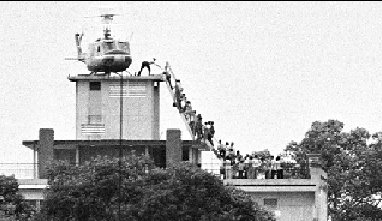
HO CHI MINH CITY, whose very name is meant to evoke the defeat of American imperialism, is about to get Intel inside. The Silicon Valley microchip maker — and icon of triumphant American capitalism — is building a $300-million factory in the city once called Saigon, a place most Americans associate with images of terrified people hanging on to evacuating U.S. choppers.

Intel Corp.'s arrival serves as an exclamation point to the remarkable transformation that Vietnam has undergone in the last decade. Like its Chinese neighbor to the north, the communist regime in Hanoi has embraced market reforms that have raised living standards and reduced rural poverty. The country may still fly a red flag, but Vietnam's young people are as eager to text message (and do deals) on their cellphones as their capitalist neighbors in Thailand are, and Intel's decision to build a plant there (instead of India) is an important vote of confidence in the nation's future.

Vietnam's opening to the outside world has been a remarkable turnaround. Long suspicious of the West and foreign investment, the country had endured so many wars — with France, the United States, China, Cambodia, itself — that its communist leadership looked singularly incapable of laying down a gun in exchange for a briefcase.

But now Vietnam's leaders are working hard to join the World Trade Organization, with negotiations entering the final stages. They are investing billions on infrastructure, and they understand that WTO membership will require more open trade and better legal safeguards for international investors.

Intel executives did not wait for the WTO paperwork to be complete. They are going ahead with plans for a mammoth new plant, announced in February and expected to be up and running by late 2007. It probably will be the largest single foreign investment ever in Vietnam, and it could double in size if all goes well in the first stage. The facility, which will package and test microchips for personal computers and mobile phones, is designed to serve Asia's booming market.

Doing business in Vietnam is not always easy, given the amount of red tape and the capricious nature of its enforcement. Still, Intel says it chose Vietnam because it could meet the chipmaker's basic needs: a reliable supply of electricity, clean water and a young workforce eager and willing to learn the tedious ropes of high-tech production.