Wednesday, April 26, 2006

DID YOU SEE IT ?? THE GREATEST ILLUMINATION FEAT IN THE HISTORY OF THE WEST.

The motion picture industry orchestrated an extravaganza to dedicate Los Angeles' new City Hall. Film producer Joseph Schenck was master of ceremonies, Sid Grauman ran the entertainment and Cecil B. DeMille arranged part of the celebratory parade, which, according to The Times, stretched over five miles and included a lion in a cage.

That night, the city experienced "the greatest illumination feat in the history of the West, when the entire lighting equipment of the Metro-Goldwyn-Mayer film studios illuminated it for its dedication," The Times reported. Irving Berlin sang at the ceremonies. From the White House, President Calvin Coolidge pressed a telegraph key to light the Charles Lindbergh Beacon atop City Hall's pyramidal tower. It all happened on April 26, 1928 and I'm sorry I missed it.

Tuesday, April 25, 2006

YES, THIS WOULD HAVE TO QUALIFY AS ANOTHER BIT OF INFORMATION THAT YOU'LL PROBABLY NEVER NEED

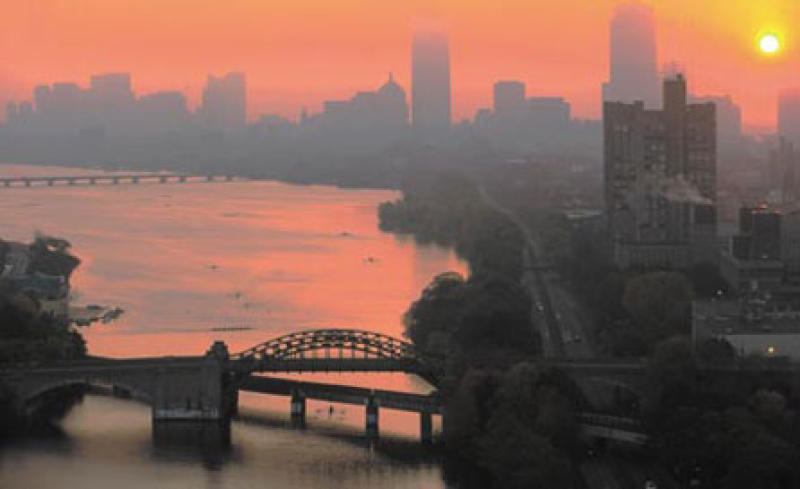
The Boston University Bridge is one of the few places in the world where a boat can sail under a train driving under a car driving under an airplane.
The Boston University Bridge at sunset.

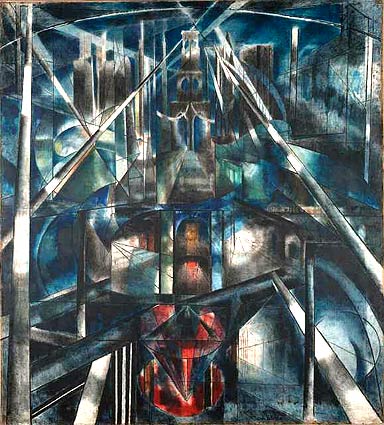
WHAT DO YOU SEE HERE ??

MODERNISM: “Brooklyn Bridge” (1919-20) was painted by Joseph Stella, one of the American artists whose work was pulled into a collection that also included the most avant of Europe’s avant-garde.

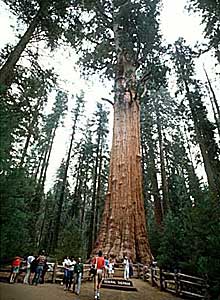
GIANT SEQUOIA TREE IS THE LARGEST LIVING TREE ON EARTH

The General Sherman Tree in California's Sequoia National Park is thought to be the world’s largest by volume, an estimated 52,508 cubic feet. Its weight is about equal to that of 10 blue whales, and it has one branch nearly 7 feet in diameter.

Sunday, April 23, 2006

THE BEAUTY OF CALIFORNIA IS TRULY INSPIRING

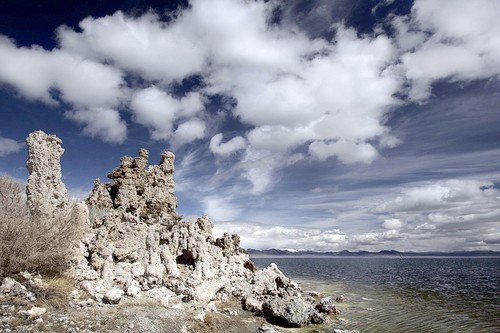
U.S. 395 takes travelers on a tour through desert and mountains, past ghost towns and motels, serene lakes and alpine ski resorts. In the image above, misty late-afternoon light hovers over the snow-covered eastern Sierra which form a spectacular backdrop to the pastoral scene below. The image below is of Mono Lake where exposed limestone tufa towers are created by freshwater springs that bubble up through the lake, which is twice as salty as the ocean.

Thursday, April 20, 2006

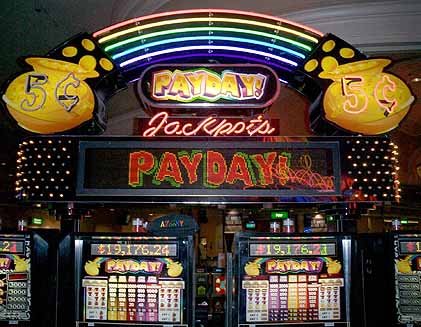
TEN MILLION DOLLARS WON ON A NICKEL SLOT MACHINE !!!

For 84-year-old Josephine Crawford, the golden years just got a lot more golden. After plunking $40 into slot machines in an Atlantic City casino, the retired waitress hit a $10-million jackpot on a nickel progressive machine. "Somehow, I'll spend it," she said. I'll bet she will.

Wednesday, April 19, 2006

HERE TODAY . . . GONE TOMORROW

NORTH KINGSTOWN, R.I. --Since the Jamestown Bridge first opened, Rhode Islanders have alternately embraced it as an enduring landmark or loathed its narrow lanes and car-shaking winds that always seemed worse on the see-through grating high above Narragansett Bay.
Smoke rises as the old Jamestown Bridge falls 135 feet into the waters of Narragansett Bay today in North Kingstown, R.I. The landmark bridge, built in 1940, connected North Kingstown and Jamestown. The steel center span of 1100 feet, which rose 240 feet, was dropped into the bay using 75 pounds of explosives. Before the Jamestown Bridge opened, Conanicut Island's only link to the rest of the state was an unreliable ferry system that often did not run in bad weather. Traffic is now routed across the nearby Jamestown-Verrazano Bridge, which was closed for the demolition.(AP Photo)

Tuesday, April 18, 2006

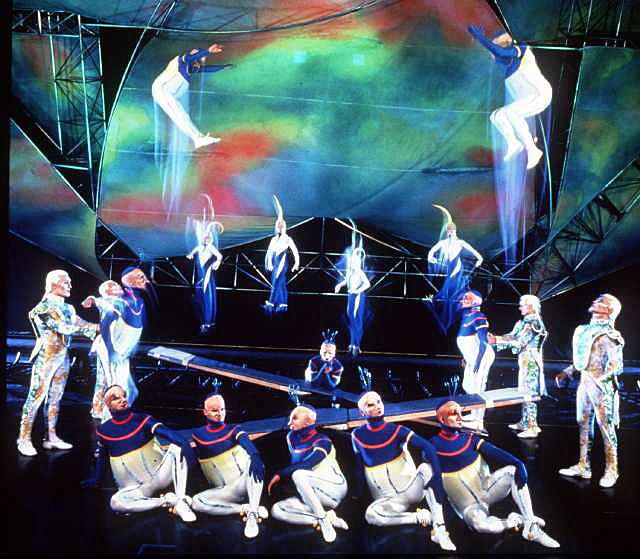
IT'S A NEW DAY WITH CIRQUE DE SOLEIL


Looking back, the Cirque de Soleil show,"Mystere" which opened in December 1993 was probably the most significant event in Las Vegas entertainment since the arrival of Elvis Presley as a regular headliner. The template for the successful contemporary Las Vegas high end resort (mixing clubs, fine dining, shopping and entertainment on equal footing with gambling) is generally believed to have started with the Mirage in 1989. But for its headliner, the property took an already well established act, "Siegfried & Roy," and built them a custom showroom. Obviously, that decision worked out brilliantly for Mirage but ducked the issue of how to move Las Vegas into more innovative entertainment than variety acts, topless showgirls and established headliners.
So, when next door to the Mirage, Treasure Island opened "Mystere" a few years later the time was more than ripe for something new, and instantly shows like "Splash" and "Jubliee!" become retro-Vegas. "Mystere" was Cirque's first free standing show (other Cirque shows toured North America) and this allowed the troupe unprecedented opportunities to innovate and create (staging, lighting and the unlimited potential of a custom theatre) that resulted in what is still thought to be the best of the French Canadian company's efforts in town.
After "Mystere"'s success Cirque became the most important entertainment creators in Las Vegas by becoming the go to team for MGM-Mirage properties. They now have four shows going. Anyway, the amazing thing is that "Mystere" is now more than a decade old and the production still seems fresh. And, yet because of its age, "Mystere" is the one Cirque show tourists even have a chance at getting things like ticket bargains and good last minute seats. Good deal.
In the most simplistic terms "O" (at Bellagio) is "Mystere" on water, "Zumanity" (at New York New York) is "Mystere" with pumped up overt sexuality, and "KA" (at MGM Grand) is "Mystere" built into a Hollywood blockbuster with magnificent and epic staging and scope. Each of the Cirque shows is really, really good in its own way. Still, if you can only see one of these shows, "Mystere" is the most integrated theatre work.
So, now back to the Mirage where, after the Siegfried & Roy show closed, the decision what to do next was now an entirely predictable one: Cirque. So, Cirque has show number five, as yet untitled (rumor is that the name of the new show will be Love), based on the music of the Beatles coming to the Mirage in late June or early July. This will be within weeks of when "Phantom of The Opera" opens at the Venetian. Interestingly this will put this latest installment of the Cirque empire into a head to head competition for attention with the latest chapter in the Broadway/Vegas nexus. Stay tuned. (The comments above, are excerpts from the Movable Buffet blogger).

What's 41 feet long, weighs 15,000 pounds, travels in packs and wouldn't mind a bite of your tri-tip sandwich ??

Could be your relatives from Wisconsin, but in this case we're talking about Mapusaurus roseae, perhaps the largest meat-eating dinosaur ever. Paleontologists say they've found fossilized remains of the beasts in Argentina. What they don't know is why the dinosaurs died.

Sunday, April 16, 2006

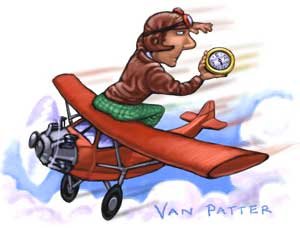
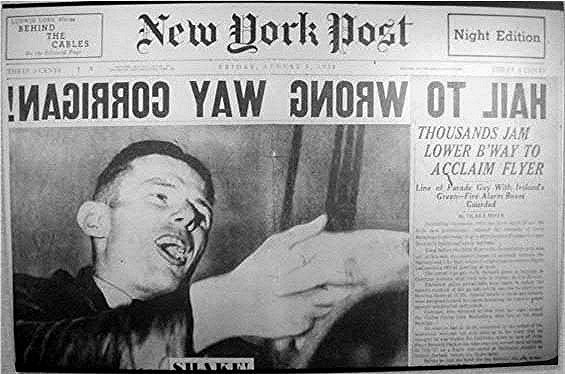
"WRONG WAY" PILOT FLIES OFF COURSE, INTO HISTORY

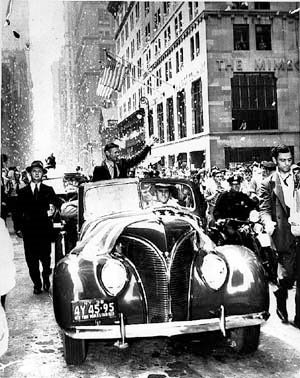
Douglas "Wrong Way" Corrigan blamed it on the clouds and a faulty compass. That's how he wound up in Ireland on his way to California, he insisted. Never mind that he'd sought permission for a transatlantic flight and twice been denied. Aviation authorities said his rickety craft would never make it across the ocean. Despite a cockpit door "latched" with wire and extra fuel tanks obscuring his vision, he landed safely near Dublin. But really, Corrigan maintained from 1938 until he died in 1995, he intended to fly from New York to Los Angeles that day.
"I made a mistake," he said.His feat caught the fancy of a world in the grip of prewar tension and the Depression. People chose to believe it was Corrigan's way of thumbing his nose at authority.
Wrong Way Corrigan riding in this parade honoring him.

Thursday, April 13, 2006

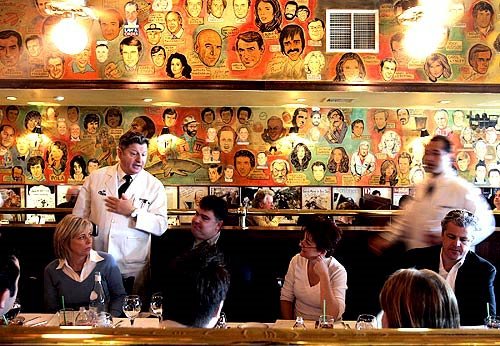
THE PALM RESTAURANT IN WEST HOLLYWOOD OPENED IN 1975---NOW THEY'RE CLOSING THEIR DOORS AND TAKING THEIR WALLS WITH THEM WHEN THEY RELOCATE

A table of L.A's elite listen attentively at the Palm Restaurant in West Hollywood to their server's suggestions while surrounded by caricatures drawn onto the walls for the past thirty years.

The mythology of the place can be traced to the East Side of Manhattan, where two Italian immigrants opened the original Palm restaurant in 1926. The story goes that without the money to decorate their fledgling steakhouse, partners Pio Bozzi and John Ganzi traded repasts of chops and pasta for drawings on the wall by local artists and cartoonists. The restaurant became a fixture in New York, up there with Sardi's and the 21 Club.

Monday, April 10, 2006

IN LIFE, IT'S ALL ABOUT HOW YOU LAND

"We lived in the wind and sand with our eyes on the stars" --- Women Airforce Service Pilots ---
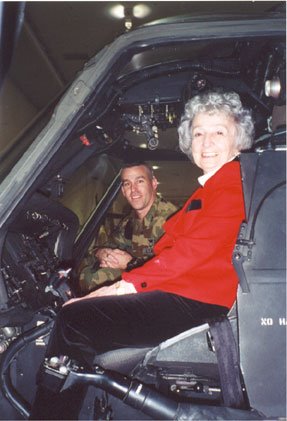
WASP Pilot Violet Thurn Cowden

How big do you have to be to fly a P-51? Obviously, at least 5'2' and 100 pounds! In addition to the P-51, Pilot Vi Cowden also flew the P-39, P-40, P-47, and P-63 during World War II. The WASP were the first women military pilots to serve the United States Army Air Force during World War II. Almost 25,000 women applied to the WASP and 1830 were accepted.

They flew wartime missions within the United States. The WASP flew more than 60 million miles in 78 different types of military aircraft - from trainers to B-29 bombers. At the time, women could not be commissioned pilots in the military and were governed by the Civil Service Commission. Thirty-eight women lost their lives and were not covered by government life insurance.

In 1979, the Secretary of the Air Force granted that long overdue recognition and veteran status to the WASP.

Vi Cowden's latest parachuting adventure came Feb. 25, when she dived with the Golden Knights, the Army's elite parachute team. With a team member behind her firmly attached by harness, Cowden plummeted through the sky for about 30 seconds. Smiling ear to ear, she spread her arms out like wings as the wind blew furiously against her face. Once the divers' parachute was released, they floated the rest of 12,500-foot drop. Her husband, 85, admitted he was "a little bit concerned" for her safety but enjoyed watching her. "It's beautiful floating down like a bird," he said.

Saturday, April 08, 2006

ANOTHER INDIVIDUAL WHO MADE A DIFFERENCE . . . A BIG DIFFERENCE

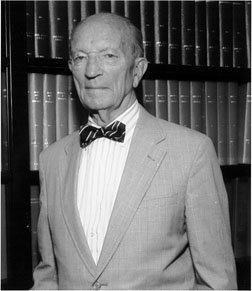
Dr. Charles Schepens, a World War II hero who helped more than 100 people escape from Nazi-occupied France and a noted ophthalmologist widely considered the father of modern retinal surgery, died March 28 of a massive stroke at his home in Nahant, Mass.

He was 94 and had received the French Legion of Honor from the consul general of France only a few days before his death. His exploits during the war were a secret known only to his family and a few others until the 2004 publication of the book "The Surgeon and the Shepherd" brought them to a wider audience, including French officials.

Born in Belgium, Schepens (pronounced SKAY-pens) had already earned his medical degree when, in the early stages of the war, he joined the Belgian air force. After its defeat, he returned to private medical practice.

He was arrested by the Gestapo in October 1940 on trumped-up charges of using a bus to transport Allied pilots out of Belgium. Although he was released 10 days later, the experience turned the previously apolitical physician into an activist, and he allowed his office to be used as a post office for underground agents, arranging for the transfer of maps and such information as troop movements.

In 1942, a spy in Gestapo headquarters alerted him that he was about to be arrested again, and he escaped to Paris, where he adopted the name Jacques Perot-Spengler, later shortened to Jacques Perot.

Looking over a Michelin map to find an escape route to Spain, he and a group of fellow resistors spied an abandoned sawmill near the town of Mendive in the Pyrenees on the Spanish border. One of the key features was a 12-mile cable car system extending up the mountain and terminating near the border.

Schepens, a rugged outdoorsman, bought the mill in July 1942 with backing from a wealthy French patriot and had it in full operation by the end of the year. The site became a functioning lumber enterprise, taking orders, delivering wood and meeting a payroll.

But men performing manual labor around the mill could surreptitiously ride the cable car system to the top of the mountain and slip into Spain, often with the assistance of a shepherd named Jean Sarochar. Sarochar died in 1975.

More than 100 Allied pilots, POWs, Belgian government officials and others made their way out of France over the cable railway. The system was also used to move documents, currency, propaganda and other materials into and out of France.

Schepens kept his profile low and cooperated with the Nazis to divert suspicion — so much so that many locals considered him a collaborator. But in July 1943, the Nazis captured a member of the Resistance who told them about Schepens' activities.

When the Gestapo showed up, he later recounted, he told them he would return to Paris to confront his accuser. Then he said, " 'You know, it is now 10 o'clock. I have 150 workers idle, because they have not been given their orders this morning. Give me 10 minutes with them. I'll give the orders and come back.' So I walked out and escaped."

He spent 16 days in the forest before reaching Spain and, eventually, England, where he resumed his medical career.

His wife and children were placed under house arrest by the Nazis, who hoped to use them to lure Schepens back. But they made their own daring escape, hiking through the mountains to reach Spain, and were reunited with Schepens in England nine months after he fled.

Back at work, the doctor began testing a theory he had developed as a medical student that retinal surgery could be performed more precisely if the surgeon used both eyes rather than looking through a monocular microscope.

He tested the theory by building a device known as the indirect binocular ophthalmoscope, piecing it together from bits of metal retrieved from his London hospital after a V-1 bomb attack. The device, which sits on the surgeon's head and leaves his hands free, is now used by surgeons worldwide and is a major reason that the success rate for reattachment of retinas has improved from 40% to more than 90%.

Schepens immigrated to the United States in 1947 and started the retina service at the Massachusetts Eye and Ear Infirmary, part of Harvard Medical School. Three years later, he established what is now the Schepens Eye Research Institute, the largest independent institute for ophthalmology research in the world.

Over the course of his career, which continued well past his retirement from Harvard in 1978, he wrote four books and published more than 360 research papers. Up to the time of his death, he was commuting to Boston three days a week to see patients.

Charles L. Schepens was born in Mouscron, Belgium, in 1912, the son of a general practitioner. The youngest of six children, he had three brothers who also became physicians. After his father died when he was 7, he was raised by one of the brothers.

Schepens studied mathematics in college before taking up the family business of medicine. But the interest in math led to his subsequent interest in ophthalmologic instrumentation. In addition to the ophthalmoscope, he developed a variety of other instruments, including micro-scissors for surgery on the vitreous, the clear gel in the middle of the eye.

According to his family, Schepens was always athletic, with a lifelong interest in woodcutting, swimming and walking.

Had it not been for the intervention of the Nazis, he might have stayed in France in the lumber business, he said.

"It was a wonderful life, you know," he told the Boston Globe in 2004.

Schepens is survived by his wife of 69 years, Marie Germaine, known as Cette; a son, Luc, of Southborough, Mass.; three daughters, Bernadette Butler of Nahant, Catherine Rojas of Petaluma, Calif., and Claire Delori of Brussels; eight grandchildren; and four great-grandchildren.

Friday, April 07, 2006

CASABLANCA TOPS THEM ALL WITH BEST SCREENPLAY

Hollywood screenwriters should know a good movie script when they see one, and "Casablanca" has been crowned the best screenplay ever.

The members of the Writers Guild of America voted Julius J. Epstein, Philip G. Epstein and Howard Koch's "Casablanca" into the top spot of the guild's 101 greatest screenplays.

In a tally announced Thursday, Francis Ford Coppola's collaborations with Mario Puzo on the first two "Godfather" scripts were both voted into the top 10 — although "Godfather III" somehow didn't make the cut.

Among living screenwriters, Woody Allen tied with Coppola (who also was honored for his work on "Patton" and "Apocalypse Now") for the most mentions with four: "Hannah and Her Sisters" (No. 95), "Crimes and Misdemeanors" (No. 57), "Manhattan" (No. 54) and "Annie Hall" (No. 6).

Charlie Kaufman ("Adaptation," "Being John Malkovich" and "Eternal Sunshine of the Spotless Mind") and William Goldman ("Butch Cassidy and the Sundance Kid," "All the President's Men" and "The Princess Bride") each earned three recognitions.

Neither the script for "Crash" nor "Brokeback Mountain," which won this year's WGA and Academy Award screenplay awards, landed on the list.

The guild, which has branches on both coasts and 9,500 film and television writer members, voted its top 10 screenplays in this order:

1. "Casablanca"
2. "The Godfather"
3. "Chinatown"
4. "Citizen Kane"
5. "All About Eve"
6. "Annie Hall"
7. "Sunset Boulevard"8. "Network"
9. "Some Like It Hot"
10. "The Godfather II"

It's a little surprising to me that Casablanca's screenplay was selected #1. There probably are better screenplays but not better movies. It's the total package that makes Casablanca the best movie ever made. Drama that is riveting, romance that tears at your heart and unforgettable characterizations that take on a life of their own are some of the elements that make Casablanca great. The magnetism of Humphrey Bogart and Ingrid Bergman is magical and compelling. Add to that the humor that is so preposterous but works so well, and then of course you have that song: Is there anyone, anywhere in the world who doesn't know the song, "As Time Goes By" ?? Many of us know the lines from many parts of the movie. One of my favorite scenes is where one of Rick's girls pleads with him, "Where were you last night?" and he answers, "That's so long ago, I don't remember." Then she says, "Will I see you tonight?" and he answers, "I never make plans that far ahead." My recollections of Casablanca make me laugh long after the film has ended.

Wednesday, April 05, 2006

A MIRACLE: NO ONE WAS KILLED

An engine malfunction apparently caused this C-5B Galaxy cargo plane, the military's largest, to crash shortly after takeoff from Dover Air Force Base in Delaware. All 17 people aboard survived though several were drenched with fuel and 14 were taken to the hospital.

Tuesday, April 04, 2006

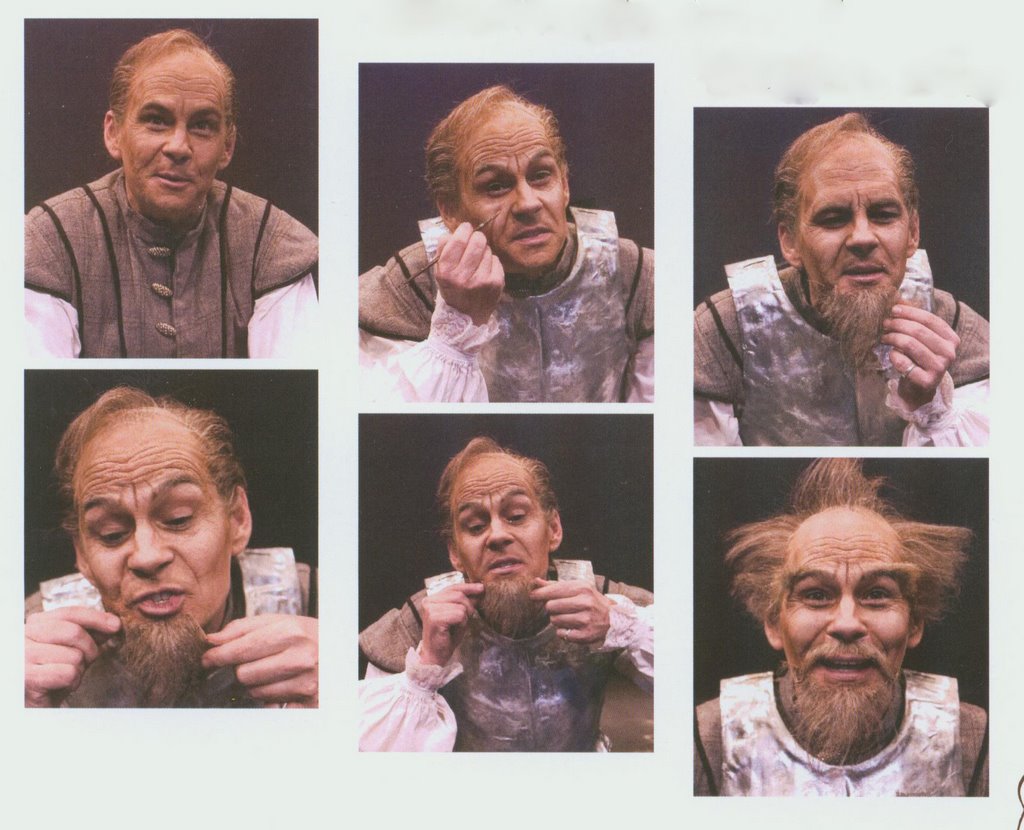
A MAGICAL PERFORMANCE THAT WILL PLEASE YOUR EAR, ENRICH YOUR LIFE AND LIVE IN YOUR HEART


El Camino's MAN OF LA MANCHA is a glorious production starring George Champion as the knight errant who chases windmills and protects the honor of wenches. Bets Danko plays Aldonza and John Massey is Sancho. This is powerful theatre that uses hopes and dreams to vanquish despair. Critics have described George Champion's performance as riveting and flawless. His rendition of "The Impossible Dream" brought chills to the audience and left them awe-struck.
The transformation of Miguel de Cervantes into Don Quixote takes place on stage before your very eyes.
George Champion and John Massey

Sunday, April 02, 2006

EIGHT-SIDED ENIGMA, CASTEL DEL MONTE IN ITALY'S BOOT, LURES VISITORS INTO THE MYSTERY OF ITS MAKER


AT Castel del Monte, the stage is set for tragedy or black magic. Clouds scuttle across the sky, and a milk-white full moon rises. Footsteps echo on cold, wheat-colored stone, startling pigeons into flight.

A medieval emperor hunted with falcons and cheetahs here, consulted astrologers and slept on Oriental silk. Local people sought refuge during the plague, and brigands hid out in the castle. Vandals over the years stripped it, leaving little more than an empty shell on a lonely hilltop at the edge of the Murge, a barren-looking limestone plateau worlds apart from the sunny Italian south most people know.

This medieval masterpiece, begun in 1240 — about the same time as Westminster Abbey — has eight sides, linked by eight eight-sided towers. Its seemingly endless repetition of the octagonal form has haunted mathematicians through the ages who see it as a work of pure geometry. The more mystically inclined impute occult significance to this temple of the octagon, noting that great buildings around the world, such as Jerusalem's 1,300-year-old Dome of the Rock, also have eight sides.

Whether icon or equation, the castle has more vibes than "The Da Vinci Code." But Castel del Monte, as silent as a sarcophagus and as strange as a UFO, keeps its secrets, glowing like the crown of its 13th century builder, Holy Roman Emperor Frederick II.

Like England's Richard the Lion-Hearted and saintly Louis IX of France, Frederick was one of the giants of the European Middle Ages, though far more complex than his contemporaries. Cultured and brutal, despotic and enlightened, a Christian crusader who was excommunicated, he left a legacy that historians still debate, including David Abulafia, author of the recent biography "Frederick II: A Medieval Emperor," which seeks to demystify the medieval ruler.

But Frederick's enigmatic aura has proved hard to dislodge. In his time and afterward, he was called stupor mundi (the wonder of the world) and the Antichrist. A 1927 biography of Frederick by German historian Ernst Kantorowicz was a favorite of Hitler, whose delusions of grandeur were fueled partly by the emperor's efforts to consolidate a realm that included Germany, the Netherlands, Austria, Poland, parts of France and Italy, Malta, Cyprus, Israel and Lebanon.

Of all the lands he ruled, he loved low-lying Puglia best, in those days a richly forested region bordered on the east by the Adriatic Sea. Here he built his startling octagonal castle, part hunting lodge, part pleasure palace, part symbol of his might.

Among great architectural ciphers, Castel del Monte stands out for its stubborn unlock-ability, though it is less well known than others chiefly because it is in the relatively untrammeled, ill-reputed Mezzogiorno, at the heel of the Italian boot.

Saturday, April 01, 2006

GOOD NEWS FROM SAIGON . . . WHOOPS! . . . I MEAN HO CHI MINH CITY


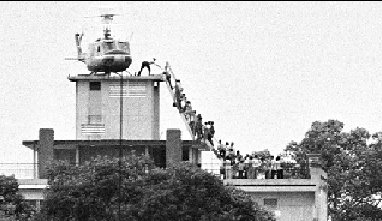
HO CHI MINH CITY, whose very name is meant to evoke the defeat of American imperialism, is about to get Intel inside. The Silicon Valley microchip maker — and icon of triumphant American capitalism — is building a $300-million factory in the city once called Saigon, a place most Americans associate with images of terrified people hanging on to evacuating U.S. choppers.

Intel Corp.'s arrival serves as an exclamation point to the remarkable transformation that Vietnam has undergone in the last decade. Like its Chinese neighbor to the north, the communist regime in Hanoi has embraced market reforms that have raised living standards and reduced rural poverty. The country may still fly a red flag, but Vietnam's young people are as eager to text message (and do deals) on their cellphones as their capitalist neighbors in Thailand are, and Intel's decision to build a plant there (instead of India) is an important vote of confidence in the nation's future.

Vietnam's opening to the outside world has been a remarkable turnaround. Long suspicious of the West and foreign investment, the country had endured so many wars — with France, the United States, China, Cambodia, itself — that its communist leadership looked singularly incapable of laying down a gun in exchange for a briefcase.

But now Vietnam's leaders are working hard to join the World Trade Organization, with negotiations entering the final stages. They are investing billions on infrastructure, and they understand that WTO membership will require more open trade and better legal safeguards for international investors.

Intel executives did not wait for the WTO paperwork to be complete. They are going ahead with plans for a mammoth new plant, announced in February and expected to be up and running by late 2007. It probably will be the largest single foreign investment ever in Vietnam, and it could double in size if all goes well in the first stage. The facility, which will package and test microchips for personal computers and mobile phones, is designed to serve Asia's booming market.
Doing business in Vietnam is not always easy, given the amount of red tape and the capricious nature of its enforcement. Still, Intel says it chose Vietnam because it could meet the chipmaker's basic needs: a reliable supply of electricity, clean water and a young workforce eager and willing to learn the tedious ropes of high-tech production.

Thursday, March 30, 2006

Mary Tyler Moore . . . We love you!


Perhaps the most famous thing about Minneapolis, at least for some of us of a certain age, is the Mary Tyler Moore show. At the end of the opening credits, she tosses her hat into the air. To commemorate the spot is this statue just outside the Marshall Field's department store.
Sierra Madre Festival and the "World's Largest Wistaria Vine"


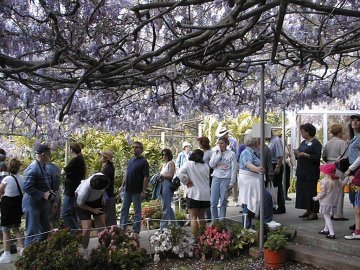
On March 29, 1937, Crowds flocked to see the lavender blossoms of the "world's largest wistaria vine" in Sierra Madre. The vine at Scenic Point had been planted in 1894, and had grown so big that in 1918 it became the star of its own annual festival. By 1937, it was said to cover more than an acre, and the fete to celebrate it lasted two weeks. By then, the vine had engulfed, and finally crushed the roof of the original house beside which it had first been planted — from a one-gallon can. A new owner of the property erected pergolas, lattices and metal supports to hold the vine. One of numerous Times articles about the festival called the vine "one of the five or six best-known Southland spectacles outside this state." The vine exists to this day, spread over two properties, and goes on public display one day a year.

Sunday, March 26, 2006

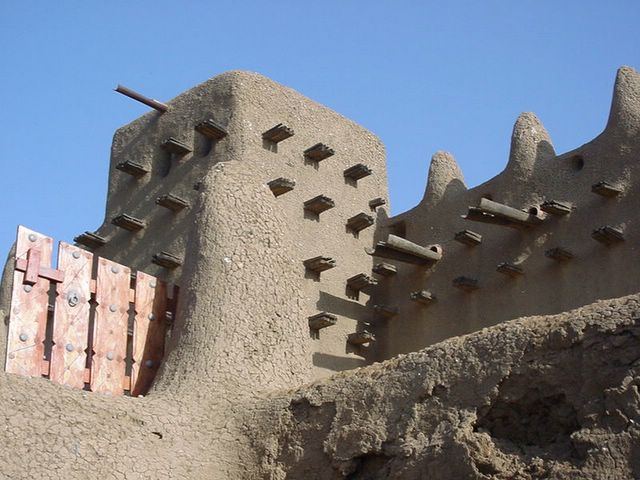
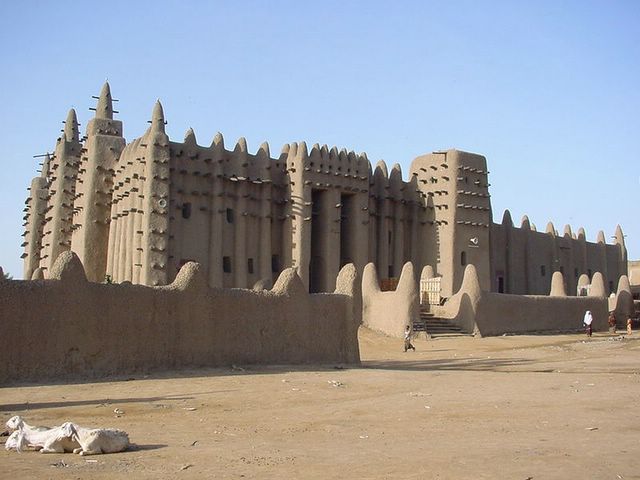
That's made of mud ????


 Posted by Picasa
The Great Mosque of Djenné is the largest mud brick building in the world and is considered by many architects to be the greatest achievement of the Sudano-Sahelian architectural style, albeit with definite Islamic influences. The mosque is located in the city of Djenné, Mali on the flood plain of the Bani River. The first mosque on the site was built in the 13th century, but the current structure dates from 1907. As well as being the centre of the community of Djenné, it is one of the most famous landmarks in Africa.

The site has been the location of a mosque since the original building was commissioned by Koi Kunboro in 1240, before Djenné emerged as a major city of the empires of Mali and later Songhai. Peul conqueror Amadou Lobbo, who took Djenné in his jihad, ordered the original mosque demolished in 1834. He considered the original structure, which had been modified from a palace, to be too lavish. The only portion of the original building that still survives is an enclosure containing the graves of local leaders. A re-creation of the original was completed in 1896 but was subsequently demolished to make way for the current structure. Construction on the current Great Mosque began in 1906 and was probably completed in 1907 or 1909.

 Posted by Picasa
The walls of the Great Mosque are made of sun-baked mud bricks called ferey, a mud based mortar, and are coated with a mud plaster which gives the building its smooth, sculpted look. The walls are between 16 in and 24 in (0.4 to 0.6 m) thick. The thickness varies depending on the wall's height: taller sections were built thicker because the base has to be wide enough to support the weight. Bundles of palm branches were included in the building to reduce cracking caused by frequent drastic changes in humidity and temperature and to serve as readymade scaffolding for annual repairs. The walls insulate the building from heat during the day and by nightfall have absorbed enough heat to keep the mosque warm through the night. Gutters, made of ceramic pipes, extend from the roofline and direct water drainage from the roof away from the walls. The prayer wall or quibla of the Great Mosque faces east towards Mecca and overlooks the city marketplace. The quibla of the mosque is dominated by three large, box-like minarets jutting out from the main wall and has eighteen buttresses. Each minaret contains a spiral staircase leading to the roof, and on top of each minaret is a cone shaped spire topped with an ostrich egg.

Water damage, in particular flooding, was a major concern of Traoré when he planned the construction. The annual flooding of the Bani River causes Djenné to become an island, and unusually high floods can inundate parts of the city. The Great Mosque was constructed on a raised platform with a surface area of 5625 m² (62,500 ft²), which has so far protected the mosque from even the most severe floods.

The entrance to Mali's Grand Mosque Posted by Picasa

Saturday, March 25, 2006

THE MAN WHO NEVER WAS


From Wikipedia, the free encyclopedia

The Man Who Never Was is a 1954 book by Ewen Montagu and a 1956 2nd World War war film based on the book. It is about Operation 'Mincemeat', a 1943 British Intelligence plan to deceive the Axis powers into thinking Operation 'Husky', the Allied invasion of Sicily, would take place elsewhere.

The film starred Clifton Webb as Lt. Cmdr. Ewen Montagu. Operation 'Mincemeat' involved the acquisition of a human cadaver, dressing it as a 'Major Martin' and putting it into the sea near Huelva, Spain. Attached to the corpse was a brief-case containing fake letters stating that the Allied attack would be against Sardinia and Greece. When the body was found, pro-German Spaniards passed the papers to the German Intelligence Service who passed them on to their High Command. The ruse was so successful that the Germans thought Sardinia and Greece were the intended objectives weeks after the landings in Sicily had begun.

The real name of the person/body remained secret, but in 1997 it was believed that he was a homeless Welsh alcoholic named Glyndwr Michael. The report was found to be inaccurate because the family that provided the body did so under one condition, that his identity never be revealed. The body was buried as Major Martin in a cemetery in Huelva, Spain.

GARBO: THE SPY WHO WAS HONORED BY THE BRITISH . . . AND THE GERMANS


From Wikipedia, the free encyclopedia

Garbo was the British codename of Juan Pujol García (February 14, 1912, Barcelona – October 10, 1988, Caracas), a double-agent who played a key role in the success of D-Day towards the end of World War II. The false information Pujol supplied to the German command helped persuade Hitler that the main attack would come later, resulting in his decision to hold back troops from the area around the D-Day landings.

Pujol was a Catalan who had developed a detestation of Nazi Germany after his experience of Fascism in Spain. He decided around 1940 that he must make a contribution to the war by helping Britain, Germany's only remaining adversary.

His wife made the first approach to the British but they showed no interest in employing him as a spy. So he resolved to establish himself as a German agent before approaching the British again to offer his services as a double-agent.

Operating initially in Lisbon, he pretended to the Germans that he was in Britain. He fabricated reports about shipping movements, successfully convincing them from information gleaned from the library in Lisbon and from newsreel reports he saw in cinemas. He claimed to be travelling around Britain and submitted his travel expenses based on fares listed in a British railway guide. A slight difficulty was that he did not understand the pre-decimal system of currency used in Britain, expressed in pounds, shillings and pence and was unable to add up the total. Instead he simply itemised the costs and said he would send the total later.

Eventually, he again made contact with British intelligence, and again offered his services. This time he was accepted.

Pujol reached Britain in the spring of 1942, and operated as a double agent under the aegis of the XX Committee. He pretended to have recruited a large network of agents, including a number of influential people with 'inside' information.

On occasions he had to fabricate reasons why his agents had failed to report easily available information that the Germans would eventually know about. For example, he reported that his (fabricated) Liverpool agent had fallen ill just before a major fleet movement from that port on the west coast of England. The illness meant that the agent was unable to warn the Germans of the event. To support the story of the illness, the "agent" eventually "died" and a notice was placed in the local newspaper as further evidence to convince the Germans, who were also persuaded to pay a pension to the agent's "widow".

The information supplied by Pujol to the Germans was orchestrated by his British handlers and included a certain amount of genuine events, in order to make the reports appear more convincing. Sometimes, this was achieved by sending genuine information but artificially delaying its arrival until the information would be harmless. For example, a letter might be postmarked with a date before some planned troop movements, but its delivery delayed until after the Germans would already have discovered the information for themselves. The Germans paid Garbo (or Arabel, as they called him) a large amount of money to support his network of agents, which at one point totalled 27 fabricated characters.

Garbo has the distinction of being one of the few people during World War II to receive decorations from both sides, gaining both an Iron Cross from the Germans and an MBE from the British.

Garbo's misinformation was part of Operation Fortitude, the effort that successfully convinced Adolf Hitler and many of the German high command to believe that the main Allied invasion was going to occur at the Pas de Calais, 150 miles east of Normandy, and that the Normandy landings were a feint designed to draw German forces away from the Pas de Calais.

After the war Pujol moved to Venezuela, where he lived in anonymity. He died in Caracas in 1988.

Saturday, March 18, 2006

MAN OF LA MANCHA: INSPIRATION THAT IS TIMELESS


To Each His Dulcinea (To Every Man His Dream)

To each his Dulcinea
That he alone can name...
To each a secret hiding place
Where he can find the haunting face
To light his secret flame.
For with his Dulcinea Beside him so to stand,
A man can do quite anything,
Outfly the bird upon the wing,
Hold moonlight in his hand.
Yet if you build your life on dreams
It's prudent to recall,
A man with moonlight in his hand
Has nothing there at all.
There is no Dulcinea,
She's made of flame and air,
And yet how lovely life would seem
If ev'ry man could weave a dream
To keep him from despair.
To each his Dulcinea...
Though she's naught but flame and air!

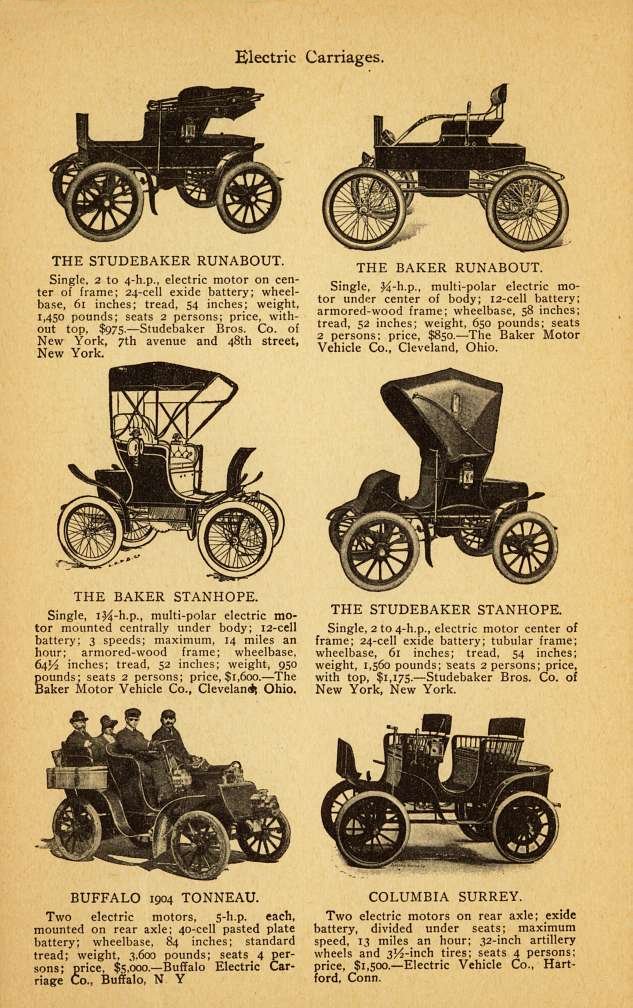
AUTOMOBILES OF 1904


TIMES PAST: MARCH 18, 1904

Ruling in Favor of Automobilists

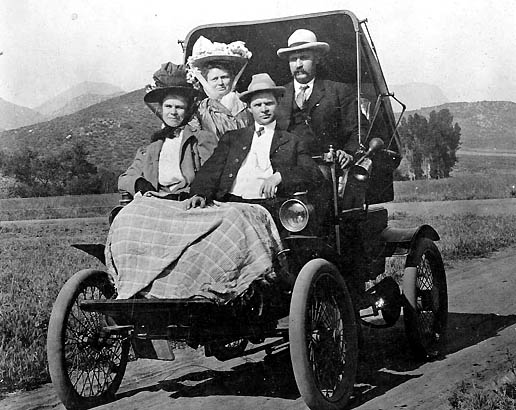
A Los Angeles judge dismissed a lawsuit brought by a woman who said an automobile passing her carriage caused her horse to shy and drop the load it was carrying. The woman, identified in The Times as Mrs. Walker, was seeking $15,000 (about $307,853 in 2005 dollars) from the driver and the man who lent him the Winton automobile, which passed her carriage on the road between Los Angeles and Rivera. But Superior Court Judge Frank F. Oster ruled that the car's driver was keeping to his own side of the road and that evidence showed the horse was skittish around automobiles. A story in The Times about the dismissal of the case ran under the headline: "In Favor of Automobilists" and said that drivers of cars were "congratulating themselves over what they consider the establishment of a valuable precedent in their favor." Shown below is another automobile of 1904: a 1904 Knoxmobile. >>

 Posted by Picasa

Wednesday, March 15, 2006

IT CAN HAPPEN EVEN IN L. A. . . . TORNADO LIFTS CARS, ROOFS AND PEOPLE


A tornado that reportedly originated near Rancho Palos Verdes tore the roofs off buildings and uprooted trees in Hawthorne, Lawndale and Lennox before heading, accompanied by fierce rain and hail, to wreak damage on factories in East Los Angeles. The Los Angeles Times said that for several minutes, "the air above Hawthorne was black with whirling tar paper." People reported being picked up and carried 50 feet to 75 feet by the twister, and others said it lifted cars off the ground. This frightening event took place on March 15, 1930. The images above and below depict the beauty and the horror of tornadoes.

Tuesday, March 14, 2006

POLICE ARREST 1400 FOR DEFYING KITE-FLYING BAN


Pakistani police arrested about 1400 people over three days to enforce a ban on kite flying imposed because of a series of fatal accidents. The government of Punjab province had imposed the ban during this year's Basant festival after kite strings reinforced with wire or glass fatally slashed seven people. Fliers often strengthen their strings before engaging in duels in which the object is to cut an opponent's string. Last year 19 people died on Basant day.
The image above shows an unusual kite, the "Peter Pan Boat Kite" . . . and, yes it really does fly.

Saturday, March 11, 2006

A PIAF INSPIRATION


Yes, I know I did an extensive posting on Edith Piaf awhile back, but she is such an inspiration for me, I couldn't resist. This is her signature piece, translated from the original French, and the emotional impact is universal.

NO REGRETS by Edith Piaff

No! No Regrets
No! I will have no regrets
All these things
That went wrong
For at last I have learned to be strong

No! No regrets
No! Let there be no regrets
Why explain?
Why delay?
Don’t go away
Simply call it a day

Fleeting moments we knew
I will set them apart
Every word, every sigh
Will be burned in my heart

But no tears will be shed
There’ll be no one to blame
Let it always be said
We attempted what came

No! No regrets
No! We will have no regrets
As you leave, I can say
Love was king
If for only a day

Life still goes on
Dare even though love has gone
One last kiss, shrug and sigh
No regrets, even though it’s goodbye

Sunday, March 05, 2006

Griffith Park's Unique Donor


 Posted by PicasaImagine a man who gives over 3,000 acres of land to his adopted hometown for a park, and then donates a fortune to build a popular observatory/planetarium/hall of science and a large open-air theater.

Imagine a man who enrages many of his peers with long years of insufferable pomposity and then shoots his well-regarded high-society wife in a paranoid delusion that she is in league with the Pope to poison him and steal his money.

Imagine if they were the same man.

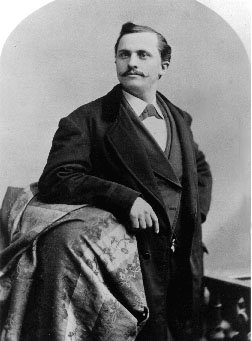
You've just imagined one of the most unimaginable characters in the history of Los Angeles, Col. Griffith J. Griffith.

Famous for Giving Griffith Park to the City, Col. Griffith, who died on July 6, 1919, is mostly remembered as donor of 3015 acres that became the core of Griffith Park, and for donating money to build the park's Greek Theatre and Griffith Observatory. But the "colonel" was a complicated man. He had towering virtues and cavernous faults. Along with other big property holders, he made enormous profits from rampant, feverish land speculation that peaked in 1886-87. And, oh yes, he married into money as well. Christina Mesmer wasn't just rich, she was also dignified and respected. They remained married for 16 years. Then in 1903 things went tragically haywire. Although the colonel was richer and more powerful than ever, he was also terribly nervous and edgy, his wife later testified. He compulsively bit his nails, his manicurist said. And he was a sneak drinker, his lawyer said, privately putting away two quarts of whiskey a day while publicly aligning himself with the city's strong temperance movement.

In August the Griffiths went to the Arcadia Hotel in Santa Monica. Christina Griffith hoped a month in the Presidential Suite overlooking the palisades would help her husband unwind. But the colonel's strange behavior intensified. Waitresses said he switched his food and drink with his wife's. You never know if someone's trying to poison you, he told them. They chalked it up to a strange sense of humor.

But the last day of the Griffiths' vacation was about as unfunny as things get. Christina Griffith was addressing a few last postcards and beginning to gather her things. Her husband entered the room with a prayer book in one hand and a revolver in the other. Unfortunately, he handed her the prayer book.

She was on her knees when the colonel aimed and fired. Christina Griffith jerked her head at the last minute. That saved her life. She hurled herself out a window, landed on an awning below, and crawled to safety through another window. One author who attended Col. Griffith's trial called Christina Griffith "the society wife who wouldn't die."


Colonel Brought to Justice

The shooting left Christina Griffith disfigured and blind in one eye. Some observers say the colonel was lucky he wasn't lynched. His trial was spectacular and ghastly. Special prosecutors, led by an ex-governor, were called in. The defense was based around a novel idea: alcoholic insanity. Earl Rogers, the colonel's attorney, argued that heavy and steady consumption of alcohol had transformed religious friction in the Griffiths' marriage--he was Protestant, she was Catholic, and they were both devout--into weird murderous delusions. The defense worked. Col. Griffith was sentenced to two years in prison, with the stipulation that he be treated for his alcoholic insanity.

Whatever it was that snapped in the colonel in 1903 apparently snapped back while he was in prison. From his cell at San Quentin, he asked that he not be given any special treatment. He passed up an opportunity to work in the prison library; instead, he made burlap sacks in the jute mill alongside humbler prisoners. He refused parole as well. One of his few remaining friends, a judge, said the colonel wanted to pay his debt to society as fully as possible.


Colonel Rebuilds His Life

When he got out of prison, the colonel had little--other than the park land he had donated to the city in 1896--to tie him to Los Angeles. Most people around town still hated him and most of the others thought he was crazy. He was divorced. His only child was independent. And he was still rich.

But he returned to Los Angeles and stayed for the remaining 13 years of his life. Sources say he was quieter and less pompous. He lectured on prison reform, advocating rehabilitation over punishment. And he persistently worked at improving his park.

In 1912 he offered the city $100,000 to build a popular observatory atop Mt. Hollywood (Formerly Mt. Griffith, it had been renamed while he was in prison.). In his letter to the mayor and city council, the colonel waxed expansively about opening up the heavens to the common people, inspiring, educating and uplifting them. "Ambition," he wrote, "must have broad spaces and mighty distances."

If someone else had made the offer, the city might have jumped at it. But, as things stood, the city council jumped the other way, flatly refusing the money. Wrote one prominent citizen in a letter published on the front page of a local newspaper:

On behalf of the rising generation of girls and boys we protest against the acceptance of this bribe . . . This community is neither so poor nor so lost to sense of public decency that it can afford to accept this money.
The colonel, however, pressed on. In 1913 he offered $50,000 to build a Greek Theater. That project also ground to a standstill. At one point the Park Commission brought suit to force the colonel to stop preparations for construction. The colonel responded by setting up a trust fund to provide money for building the two facilities he had promised after he was gone.

Millions have enjoyed Griffith Park during the nearly 100 years since Col. Griffith donated it to the city. The Greek Theatre has stood for 65 years, the Observatory for 60.