Tuesday, June 27, 2006

THE MUSIC OF THIS AMAZING TALENT IS MYSTICAL, MAGICAL AND UNFORGETTABLE

This new all-original music CD is the 16th CD release by best-selling piano artist, Mike Strickland. This solo piano recording is like a combination between a stunning piano concert and a gorgeous movie soundtrack.

Born into a musical family in Jackson, Mississsippi, Mike has been creating music since he was a young child. Formal piano lessons were followed by music composition studies at Berklee School of Music in Boston and California State University Northridge. Mike's professional career started while he was at college with the discovery that instead of studying for his business degree, he was composing and playing music 5 to 6 hours a day.

In 1987, his recording studio and company, Mike Strickland Productions, Inc. was formed. That same year, he recorded his first album of original music entitled "Floating". This upbeat, creative recording soon attracted the attention of CBS Sports producer, Frank Chirkinian and was used for the PGA Golf telecasts for several seasons.

Since that time, Mike has produced 14 more CD releases entitled: "Time Remembered"-1990; "Christmas Time"-1991; "Traveling On"-1993; "My Favorite Things"-1994; "My Favorite Things, Vol. 2"-1995; "Starry Night"-1995; "Music Of The Night"-1996; "Moonlight"-1997; "On The Wind"-1998; "The Piano"-1999; "Jazz, Blues and Boogie"-2000; "Duo"-2001; "Touch The Sky"-2003; "All-Time Piano Favorites"-2003.

In the last 20 years, Mike has performed extensively all over the United States as a solo artist and with various groups. To date, he has recorded 15 CDs on his own label, MSP Records. His recordings have been broadcast nationally on several radio and television programs. His music is also broadcast through several foreground music companies via satellite to 40,000 businesses nationwide, and has been distributed commercially to gift and specialty store markets throughout the USA including DisneyWorld gift properties and The Sharper Image stores.

Check out the Mike Strickland website: http://www.mikestrickland.com/

Monday, June 26, 2006

Did someone say the electric car was dead ??

Ian Wright, the New Zealand-born founder of Wrightspeed Inc., takes his electric sports car out for a spin in the hills near his home in Woodside, Calif. The retooled Ariel Atom race car is a prototype of the car he eventually hopes to sell. (AP)

Sunday, June 25, 2006

A spectacular shot of a simple scene . . .

This photo of the Los Angeles River and the Balboa Boulevard Bridge in Reseda was taken by John Humble.

Hi !! Do you know me ??

"LANDMARK" is a word perhaps too loosely applied in this day and age. Yet say, "Round building off the 405 at Sunset," and what L.A. local doesn't know the former Holiday Inn?

Passing motorists would be forgiven for not knowing that it is now the Hotel Angeleno, operated by San Francisco-based hospitality company Joie de Vivre. New paint and lights haven't exactly reinvented the cylindrical exterior, but the 209 rooms inside have gotten more notable updates. Why would Joie de Vivre buy an old Holiday Inn with freeway-adjacency issues? The 17th floor tells all. That's where West, a new Italian steakhouse and lounge, floats over a view that stretches from downtown to the Pacific. At night, guests and locals will surely sip cocktails and be mesmerized by the river of lights that is the freeway. But the sunlit happy-hour provides a far superior view — at least on a clear day.

BUTTERFLYS ARE FREE

A glass-enclosed butterfly-shaped structure houses the Dancing Wings Butterfly Garden™, Upstate New York’s first indoor butterfly garden, which features free-flying North American and tropical butterflies throughout the year.

THE RAPIDLY DISSAPPEARING ICE CAP

The Greenland ice sheet — two miles thick and broad enough to blanket an area the size of Mexico — shapes the world's weather, matched in influence by only Antarctica in the Southern Hemisphere. It glows like milky mother-of-pearl. The sheen of ice blends with drifts of cloud as if snowbanks are taking flight.

In its heartland, snow that fell a quarter of a million years ago is still preserved. Temperatures dip as low as 86 degrees below zero. Ground winds can top 200 mph. Along the ice edge, meltwater rivers thread into fraying brown ropes of glacial outwash, where migrating herds of caribou and musk ox graze. The ice is so massive that its weight presses the bedrock of Greenland below sea level, so all-concealing that not until recently did scientists discover that Greenland actually might be three islands.

Should all of the ice sheet ever thaw, the meltwater could raise sea level 21 feet and swamp the world's coastal cities, home to a billion people. It would cause higher tides, generate more powerful storm surges and, by altering ocean currents, drastically disrupt the global climate. Climate experts have started to worry that the ice cap is disappearing in ways that computer models had not predicted.

By all accounts, the glaciers of Greenland are melting twice as fast as they were five years ago, even as the ice sheets of Antarctica — the world's largest reservoir of fresh water — also are shrinking, researchers at NASA's Jet Propulsion Laboratory and the University of Kansas reported in February.

ARIZONA FIGHTS WILDFIRE

The Brins fire burns in the Wilson Mountain, threatening Oak Creek Canyon, near Sedona. Authorities evacuated about 400 homes and businesses in Oak Creek Canyon.

Saturday, June 24, 2006

NEW "NOAH'S ARK" TO SAVE THE SEEDS OF THE WORLD

London: An ambitious project to safeguard future food supplies began on Monday with the launch of a ``Noah's ark'' for the world's most important plants. Above we see a vat being filled with seeds at the global seed bank in Longyearbyen, Norway, on Monday.

The new Svalbard International Seed Vault will serve as a repository for crucial seeds in the event of a global catastrophe, said Norway's Agriculture Minister Terje Riis-Johansen. Carved into the permafrost and rock of the remote Svalbard peninsula, it will eventually house 3 million seed samples from every country in the world. This facility will provide a practical means to re-establish crops obliterated by major disasters,'' said Cary Fowler, executive secretary of the Global Crop Diversity Trust, which will manage the seed bank. ``But crop diversity is imperilled not just by a cataclysmic event, such as a nuclear war, but also by natural disasters, accidents, mismanagement, and short-sighted budget cuts.''

Agriculture relies on collections of crop species and their wild relatives. Seed banks are vital to the development of new crop varieties and, without them, agriculture would grind to a halt. Samples of the world's agricultural biodiversity, including crops such as wheat, apple and potato, are scattered across 1,400 seed banks around the world. All these seed banks are at risk from local problems. Mr. Fowler cited the example of the wars in Iraq and Afghanistan and the 1994 genocide in Rwanda as times when dozens of unique crops had been wiped out. The Norwegian government and the Global Crop Diversity Trust have worked on the idea of building a global seed bank of last resort in the Arctic ice since 2004.

On Monday, the Prime Ministers of Norway, Sweden, Denmark, Finland and Iceland launched the $4.8 million project at a ceremony near the town of Longyearbyen, in Norway's remote Svalbard Islands, roughly 990 km from the North Pole.

The new seed bank will store its samples in a reinforced concrete tunnel drilled 70 metres into a mountain, guarded by two steel doors and remote-controlled from Sweden. The seeds will be stored in foil packets at minus18C, and are expected to remain viable for thousands of years. If a crop is lost through natural disaster or war and a seed bank is destroyed, a government could request replacement seeds from the vault. The facility's remote location and permafrost will ensure that, even if the power fails, the temperature will never rise above freezing. The UN Food and Agriculture Organisation estimates that 75 per cent of the genetic diversity of agricultural crops has been lost. The U.S. had 7,100 varieties of apple in the 19th century, 6,800 no longer exist. The seed bank will start accepting samples in 2007. Norwegian Prime Minister Jens Stoltenberg said it would be of global importance. "It will be the only one of its kind. It is our final safety net." © Guardian Newspapers Limited 2006

Friday, June 23, 2006

In TIMES PAST: 1910 Flanders Touring Car Soars Over Downtown L. A.

June 23, 1910: As an advertising stunt for the Lord Motor Co., balloonist Ed Unger tied a Flanders automobile to a large hot-air balloon and ascended 1,000 feet from a vacant lot at 8th Street and Broadway. Unger and Lord salesman Ed Adams were in the balloon's basket.

"Though the car swayed dangerously, Unger pluckily kept his seat," The Times said. "Near him was the trapeze rope, which he could have grasped if the voyage had become too tempestuous." A crowd gathered at the lot, waiting for hours before the ascent and staying to watch as the car hovered overhead for an hour while Unger threw down cards and pamphlets. The "stylish little car" took its trip skyward without its engine, which had been removed. (the photo above shows a 1910 Five Passenger Flanders Touring Car).

"ON A CLEAR DAY YOU CAN SEE FOREVER"

The trail overlooking the Great Western Divide near the Bearpaw High Sierra Camp provides one a spectacular view. Some worry the camps are disruptive, but Bill Tweed of Sequoia and Kings Canyon National Parks says they are "a pleasant leftover from a world with much fewer human beings." (Brian Vander Brug / LAT)

OUR NEWEST NATIONAL PARK

Hikers explore the Great Sand Dunes National Park. The United States' newest national park in Colorado has the tallest sand dunes in the nation. (Hal Stoelzle)

LIFTOFF

Skateboarder Danny Way is set to defend his big air title in the X Games after jumping the Great Wall of China four weeks ago. (Peter Parks / AFP / Getty Images)

Thursday, June 22, 2006

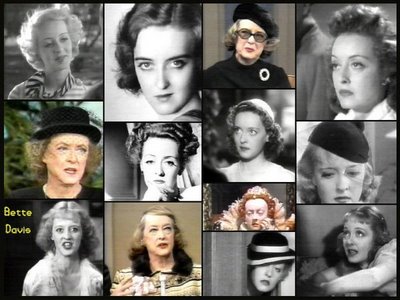
"WHY ASK FOR THE MOON WHEN WE HAVE THE STARS" and Bette Davis was a big one !!

  Posted by PicasaIt only takes a film clip to bring it all back — those eyes, that voice, the inevitable look of amused contempt cutting through a sorcerer's haze of cigarette smoke.

During her life, Bette Davis had few peers, and almost 20 years after her death, no actress has even attempted to follow in her footsteps. Probably because the walk alone is beyond the ken of most modern starlets. Two parts what-are-you-looking-at and one part scoot-forward-you'll-get-a-better-view, that elbow-levitating, hip-swinging sashay adored by drag queens for decades distilled the fascinating contradiction of the woman.

Not that there is any one Bette Davis image. Other stars of her era may be more easily summoned to mind — Katharine Hepburn, say, or even Joan Crawford. The Davis oeuvre is more varied than most of the other strong-minded gals of her time — she did Southern belle, she did British monarch, she did New York socialite and aging starlet. The accents may have been a bit perilous, but the stubborn New England fearlessness never was.

Here was someone who would pause mid-stride to light her cigarette off a burning orphanage and, still, you had to love her.

Two recent attempts have been made to explain why. Charlotte Chandler's recent biography, "The Girl Who Walked Home Alone," which was excerpted in a recent Vanity Fair, relies much on several years' worth of interviews with the star. It's a bit like a historic tour of Davis' life with Davis, in all her deadpan staccato splendor, as tour guide. "It was said in my family," the book opens, "that one of my ancestors was a witch. Well, I certainly hope so. It would explain everything." (Davis was one of those people who spoke habitually, and effectively, in italics.)

"Stardust: The Bette Davis Story," which premiered recently on Turner Classic Movies, took a longer view. The documentary obviously originates from a place of homage. Davis, the filmmakers believe, was not only a brilliant actress but also a feminist trailblazer.

Feminist may be a bit of a reach — one TV interview has Davis firmly announcing that it is the role of the "girl" to subsume her life to that of the man, otherwise the marriage won't work. With four failed marriages, she certainly would have known, but it didn't seem to occur to her to question these supposed requirements of marriage.

Beyond that, it is remarkably clear-eyed about its subject, who was a very complicated person, with as many obvious failings as talents. Unlike the recent TV biography of Eugene O'Neill, for instance, in which everything from the playwright's alcoholism to his abandonment of his own children was explained neatly away by his having been "haunted" by an imperfect early family life, "Stardust," like its dyed-in-the-wool Yankee subject, is much more matter-of-fact.

Davis too came from a broken home; her father, never too pleasant to begin with, abandoned his wife and two young daughters to live with his mistress. Bette's mother, Ruthie, quickly poured her considerable energy into her daughter's nascent dramatic career. When a very young Bette came down with measles after landing a plum role — Hedvig in "The Wild Duck" (the part that wakened in Bette the desire to be an actress) — Ruthie promised the director she'd have her daughter up on her feet in 10 days, and she did.

Their relationship would remain intense and symbiotic until Ruthie's death, but while Jones does lay some of Davis' subsequent trouble with men at the feet of her childhood, he is not a Davis apologist. That she was driven, ambitious, probably alcoholic, sometimes violent, always outspoken and ruthlessly certain of her own significance is not, mercifully, fodder for biopic psychoanalysis.

Instead we are shown the extraordinary career that sprung from such a personality — the woman made more than 90 films, many of them classics — as well as the life required to make that career possible. Because, as she said herself many, many times, the work was what really mattered to her.

Which is a good thing because Davis did not have a particularly happy life. Along with the four marriages, she had three children, two of them adopted. One daughter was mildly retarded and institutionalized; the other, B.D., was Davis' constant companion for years, until she wrote a tell-all book that severed their contact. Only her son, Michael Merrill, was interviewed for "Stardust," and though he speaks of his mother with a vague fondness, he is still clearly a bit shellshocked by the experience of being Bette Davis' son.

Part of this is due to the nature of the time. Davis was a movie star when being a movie star was a full-time occupation. She often made as many as three films a year; in the banner year of 1939, she made four. Her personal struggles with Jack Warner, to whom she was under contract for 18 years, were legendary — "She never had an unkind word for Jack," Frank Sinatra said at a banquet honoring Davis. "And the time she stabbed him, it was an accident. She was in his office and she reached for the revolver, the knife slipped out."

Even during the years when she was in hit after hit —she was nominated for 10 Oscars (five in consecutive years) and won two — the industry's devotion, then as now, lasted only a few minutes after the latest box office tally. When she hit her 40s, she learned, as so many actresses have, that age does matter. (It also doesn't help when you've earned a reputation for being almost impossible on the set.) Even after the sweeping success of "All About Eve," in which she played a fading star at the ripe old age of 42, leading film roles were scarce. The late '50s and early '60s were full of television work as Davis struggled to support herself, her children, her sister and her mother.

Beyond a collection of some of the best moments in American film and a mildly intimate look at a woman so well known she was almost her own caricature, what emerges from "Stardust" is the vacuum that Davis and some of her contemporaries left behind. Where is an actress alive today who could utter lines like "I'd kiss ya, but I just washed my hair" or "But you are, you are in that wheelchair, Blanche" or even the classic "What a dump." And where are the writers to write them?

Davis' list of successful films is low on romantic comedies, high on character dramas, and within them she created a series of women who may have wanted to be loved (who doesn't?) but who were also perfectly capable of letting their dream man go with a quip and a shrug if it looked as if he was going to get in the way of what she really wanted. The plot may have required Margo Channing to deliver a nice little soliloquy on the importance of being there for your man, but somehow the audience knew that Eve or no Eve, Margo wasn't going to change one whit.

Imagine an actress today building a successful career with a persona like that. Imagine a series of female-driven films in which the women were allowed to be smart and mouthy and not play second banana, or calculating and vulnerable but not punished for either? A film in which a happy ending was marked by a rueful smile and the admission that the star-crossed couple would just have to remain star-crossed?

Davis was perhaps one of the last of her kind — a Movie Star Who Wanted to Be a Movie Star, who made no apology for grabbing the roles she wanted, who worked pretty much nonstop all her life even when it meant doing "Gunsmoke" and playing creepy nannies, who didn't pretend that she was just like her fans, that she also wanted a "normal" life.

And so she remained, to the end of her life and mostly by the force of her own will, a Big Star, with the cigarette going and the false eyelashes fluttering while she uttered scathing one-liners in that perpetually heartbreaking, heartbroken voice.

Bette Davis, undiluted.
Bette Davis

Monday, June 19, 2006

TURNING TO A KINDER CUT

This is 21st century surgery — with little blood loss, rapid healing and minimal scarring — and it's quickly replacing surgery in which scalpels (in, hopefully, steady hands) slice long, bloody incisions through the body. In this dynamic movement, doctors aim to fix the body without hurting it.

"People will soon look back at any large incision as barbaric and archaic," says Dr. Paul A. Wetter, chairman of the Society of Laparoendoscopic Surgeons and a professor emeritus of gynecology at the University of Miami. In only the last few years, minimally invasive surgery has evolved from a popular technique used for the simplest of abdominal surgeries — such as a gallbladder removal or hernia repair — to a method that can treat even life-threatening diseases such as cancer, heart problems and emphysema.

An increasing number of these surgeries are augmented with sophisticated computer and imaging technology — such as robots. Such techniques elevate ordinary doctor skills to the super-human level by providing magnified, high-definition images and by preventing mistakes, such as cutting into the wrong tissue. Some doctors are even taking the first tentative steps toward operating without incisions, using the body's natural openings — the nose, mouth and anus — to gain access to its inner workings.

Think of it as surgery without scars.

Saturday, June 17, 2006

THE PRESIDENT ACTS TO PROTECT MARINE LIFE

Spinner dolphins frolic near Midway Atoll, in a region rich in marine life that includes green turtles, monk seals and millions of nesting seabirds. President Bush this week created the world's largest marine protected area, 140,000 square miles of the Pacific Ocean, including the area around the atoll. (Photo by Rick Loomis / Los Angeles Times)

OLD LADY OF THE FREEWAY

I'm not much for murals but the "Old Lady of the Freeway" created by Kent Twitchell in 1974 was memorable as it presided over the 101 Freeway in L A for years.

DEFYING GRAVITY

“The Glories of Erosion” by Carmine Iannaccone appears to defy gravity. A cleat on a gallery wall catches “Glories” edge, keeping it from collapsing and forcing an extreme cantilever. Iannaccone’s landscapes are at Solway Jones in L A through July 2.

Wednesday, June 14, 2006

PLANNED HIGH-RISE: An architectural rendering of the hotel and residential tower at the Los Angeles Convention Center.

The remaking of downtown Los Angeles will gain a crucial missing piece today when developers unveil plans for a 1,000-room hotel complex — including a five-star Ritz-Carlton and a four-star Marriott Marquis — for the Convention Center. Rising 54 stories, the $750-million project would be one of the largest buildings in Los Angeles at 2 million square feet.

The proposed 124-room Ritz-Carlton would be the first five-star hotel downtown and, with the largest ballroom in the city, the planned 876-room Marriott Marquis would fill a void as a business meeting hub at the Convention Center. The hotels are to be topped by 216 luxury condominiums.

The project, scheduled to open in 2010, would anchor L.A. Live, the 27-acre sports-entertainment complex considered the linchpin of downtown's redevelopment.

Monday, June 12, 2006

IN A FEW YEARS YOU MIGHT BECOME A CLEVER DRIVER

British engineers have unveiled a three-wheeled car that, at a metre wide, is designed to squeeze into the tiniest of parking spaces. Funded by the European Union and backed by BMW, it is trumpeted as more environmentally friendly than the average vehicle because it runs on compressed natural gas.

The car, called Clever (for compact low emission vehicle for urban transport, and a possible swipe at the Smart car brand) was launched at Bath University in south-west England, one of the centres behind the three-year project. Its developers hope to see it on European streets within five years at a cost of as little as £5000 the equivalent of 12,000 American dollars.

Sunday, June 11, 2006

"PHANTOM -- THE LAS VEGAS SPECTACULAR" SET TO OPEN AT THE VENETIAN

On June 12 "Phantom" begins haunting the Venetian in a 95-minute version of Andrew Lloyd Webber's musical "The Phantom of the Opera." The Strip's version, dubbed "Phantom — The Las Vegas Spectacular," features new special effects and although abridged, it includes every song from the Broadway production. Tony-winner Anthony Crivello and "Chicago" veteran Brent Barrett share duties as the phantom. Venetian's Phantom Theatre, 3355 S. Las Vegas Blvd. $107-$132. Preview shows June 12-23 (dark Tuesdays). (866) 641-7469, http://www.venetian.com/phantom .

Saturday, June 10, 2006

JUDY GARLAND TO BE COMMEMORATED ON U. S. POSTAGE STAMP

Stage and screen legend Judy Garland will be commemorated on a postage stamp as part of the Postal Service's Legends of Hollywood series. The new stamp is to be unveiled today in New York on what would have been Judy's 84th birthday.

The actress known across the globe for her movie musical turn as Dorothy in "The Wizard of Oz" will become the 12th inductee into the collection issued by the U.S. Postal Service. Born Frances Ethel Gumm on June 10, 1922 in Grand Rapids, MN, the actress grew to become an all-around performer, acting in comedy or drama, singing and dancing.

In 1940, Garland won a special Academy Award "for her outstanding performance as a screen juvenile during the past year" — having appeared in "The Wizard of Oz" and "Babes in Arms." Other films include "For Me and My Gal," "Meet Me in St. Louis," and Academy Award nominated roles in "A Star Is Born" and "Judgment at Nuremberg." Following her acclaimed, self-titled performance run at Broadway's Palace Theater in 1951, she was honored with a special Tony Award. Garland has also appeared as a pivotal character in Broadway's "The Boy From Oz" and Off-Broadway's current "The Property Known as Garland." Art director Ethel Kessler designed the stamp using a portrait of Garland by Brooklyn artist Tim O'Brien based on a publicity photo for "A Star Is Born." A reproduction of Garland's signature appears across the bottom of the stamp. (shown above)

WORLD CUP CRAZE IN GERMANY

World Cup fans are projected on high-rise buildings in Frankfurt, Germany. Photo by Bernd Kammerer / AP.

Friday, June 09, 2006

IN LAS VEGAS THEY'RE PLAYING WITH A STACKED DECK

In the photo above a sheriff's deputy looks out on the Las Vegas Strip from the new $185-million Clark County courthouse. One Southern California lawyer said "I don't think what goes on in Nevada bears any resemblance to a justice system," referring to reports that some judges routinely rule in cases involving friends, former clients and business associates -- and these judges rule in favor of lawyers who fill their campaign coffers. Coincidentally, state casinos raked in $989.8 million in winnings from gamblers in April, a 12.7% increase over the previous year and the highest amount ever for the month, state regulators said in Carson City. Of the April total, the state collected $52.9 million in fees. For the fiscal year that began July 1, statewide casino winnings total $10.1 billion, 12.5% over the same time last year, regulators said.

CLOUD GATE REFLECTS THE WORLD WE LIVE IN

Cloud Gate is British artist Anish Kapoor's first public outdoor work installed in the United States. The 110-ton elliptical sculpture is forged of a seamless series of highly polished stainless steel plates, which reflect the city's famous skyline and the clouds above. A 12-foot-high arch provides a "gate" to the concave chamber beneath the sculpture, inviting visitors to touch its mirror-like surface and see their image reflected back from a variety of perspectives.

Inspired by liquid mercury, the sculpture is among the largest of its kind in the world, measuring 66-feet long by 33-feet high. Cloud Gate sits upon the AT&T Plaza in Chicago, Illinois.

"What I wanted to do in Millennium Park is make something that would engage the Chicago skyline…so that one will see the clouds kind of floating in, with those very tall buildings reflected in the work. And then, since it is in the form of a gate, the participant, the viewer, will be able to enter into this very deep chamber that does, in a way, the same thing to one's reflection as the exterior of the piece is doing to the reflection of the city around."
-Anish Kapoor

Wednesday, June 07, 2006

Tuesday, June 06, 2006

BARRY MANILOW: CRIME FIGHTER UNAWARES

A local council in Sydney, Australia, is taking radical measures against car-revving youths — the calming tones of singer Barry Manilow. Beginning in July, Manilow's greatest hits will be piped into one car park in a bid to drive the youths away. Bill Saravinovski, deputy mayor of Rockdale, a suburb of Sydney, said the decision was taken because the youths were intimidating local people.

Saravinovski said the Manilow songs should not annoy residents, but would be loud enough for the youths to hear it. "Daggy music is one way to make the hoons leave an area, because they can't stand the music," he told the Australian newspaper the Daily Telegraph. "Daggy" is Australian slang for unfashionable or uncool. (from BBC.com)

Sunday, June 04, 2006

Do you feel like pampering yourself ??

The ever-growing St. Regis chain is set to open another of its luxury accommodations, this time in French Polynesia. The St. Regis Bora-Bora, set on 44 acres, has 91 villas (including five over water that have swimming pools that also are over water). The one-bedroom units are 1,550 square feet and start at $950 a night. Guests have their choice of three restaurants, a spa and two pools (one with swim-up bar). And each villa comes with a butler, of course.

COUNTDOWN TO MADNESS

A soccer ball globe sculpture glows in the light of Berlin’s Brandenburg Gate. Germany has been preparing for six years to host the World Cup, which begins Friday.

HAPPY MEALS ??? NOT FOR EVERYONE

FAST-FOOD industry, stand in the corner. When it comes to kids' meals, you've been very naughty. Once upon a time, it seemed OK to push fatty burgers, nuggets and fries onto little kids, but that's so yesterday. You're older now and ought to know better. Some of you claim to have healthful options, but it doesn't count if all you've done is replace the fatty fries with something super-sugary. Do apple slices really need to be dipped in caramel sauce? Instead of toys, those meals should come with insulin.

SOME PEOPLE CALL THIS ART . . . BUT I CALL IT HUMOR

When L.A. County supervisors laid eyes on Kienholz's sculpture of a drunken couple making out in a car — a week before the opening of a 1966 exhibition at LACMA — they labeled the artwork "revolting" and "blasphemous," urged museum officials to remove it and threatened to cut their salaries when they refused. The show opened on time, with a long line of viewers and the door of the car closed. But guards stationed at "Back Seat Dodge '38" opened the door periodically, allowing patient visitors to peek inside.

Thursday, June 01, 2006

DEADLY QUEST

There have been 10 fatalities among an estimated 300 Mt. Everest summit attempts so far this season; the cost of joining an expedition can run from $10,000 to more than $40,000.

Tuesday, May 30, 2006

Why are the makers of MONOPOLY kicking Atlantic City's landmarks off its prime real estate ??


By Rod Kennedy Jr., author of "Monopoly: The Story Behind the World's Best-Selling Game" (2004, Gibbs Smith) and the originator of "Atlantic City, 125 Years of Ocean Madness" (Ten Speed Press).

IN 1935, PARKER BROS. introduced Monopoly, a real estate trading game that has gone on to become the world's bestselling game, with more than 250 million copies sold in more than 80 countries to date.

One of the unexpected side effects of the game's extraordinary success was to make famous — indeed, to make iconic — the streets of Atlantic City, N.J., the seaside town where the original, classic "Number Nine" Monopoly game board was set. Today, it probably would be difficult to find an American child (or perhaps an American of any age) who is not familiar with Baltic Avenue, Marvin Gardens or, certainly, the prime real estate properties of Park Place and Boardwalk.

But 20 years from now, that may no longer be true. Hasbro, the current owner of Monopoly, recently announced that it is coming out with a new version of the game called "Monopoly: Here and Now," which is slated to become the company's new flagship edition. In it, the well-known Atlantic City landmarks will be replaced with "legendary streets, neighborhoods and national monuments from 22 cities — ranging from New York City to Honolulu." Hasbro is holding an online election on the Monopoly website where people can help select the locations that make it onto the new board.

But sadly — and in my opinion, wrongly — Hasbro has omitted Atlantic City from the list of candidate cities, generating an uproar from die-hard fans around the world. After all, what American street is more legendary than the Boardwalk in Atlantic City?

I'm particularly aggrieved by all this. Like many people, I once thought that the vividly colored properties on the classic board were fictional places that existed only as I envisioned them in my imagination. It was one of the great discoveries of my life to learn that these properties really do exist.

On my first visit to Atlantic City in 1973, I was thrilled to actually take a walk on the Boardwalk and to advance to St. Charles Place. The grand hotels that lined the Boardwalk like giant sandcastles were a wonder to behold, and the entertainment piers that jutted out into the sea were awesome.

As I learned more about Atlantic City, here are some things that I found out:

• Mediterranean and Baltic avenues really were "on the wrong side of the tracks" — the Pennsylvania and Reading Railroad tracks. Baltic Avenue was known for offering accommodations to African American visitors, and many of the kitchen and housekeeping workers who staffed the hotels on the Boardwalk lived there.

• Oriental Avenue was named for a rug shop and, along with Vermont and Connecticut avenues, once comprised a middle-class Jewish neighborhood that was filled with boarding houses and kosher delis, and dominated by a giant lighthouse where the Coast Guard kept an eye peeled for enemy subs during World War II. On the Monopoly board, the "light blues" are in a sweet spot of low cost and decent return — much as they were in real life.

• Kentucky Avenue once was known as KY-at-the-curb because it was lined with black nightclubs such as Club Harlem at 32 North Kentucky, which featured stars such as Billie Holiday, Cab Calloway and Sammy Davis Jr. In the early days, Club Harlem hid its gaming in the side room while showcasing the cream of America's black show business talent for a mostly white crowd.

• The President Hotel on the Boardwalk was conceived as a "summer White House," but no president ever slept there. In fact, Calvin Coolidge refused to stay there when he visited Atlantic City. The Taj Mahal of the Atlantic City boardwalk was the palatial Blenheim hotel, built in 1902 — a melange of domes and monoliths with deep porches and hooded windows.

• Atlantic City was considered "free parking" or "neutral turf" for gangsters during Prohibition and where they could gather without fear of being "whacked." In 1929, Al Capone held a crime convention there much like the Elks, Odd Fellows and Shriners.

• The jail was actually in the City Hall on the corner of Tennessee and Atlantic avenues, not on the corner of Connecticut Avenue and St. Charles Place as it is on the game board. Before Atlantic City had a jail, prisoners were handcuffed to trees in the mayor's yard.

• My parents spent their honeymoon in Atlantic City and stayed at the Shelburne Hotel on the Boardwalk. I was born nine months later.

Even though I have been assured that Hasbro will continue to produce the classic "Number Nine" version of the game for the time being, I fear the "Here and Now" version may signal its eventual demise — just as gambling and casinos did for the grand hotels and entertainment piers in Atlantic City itself. I call on Hasbro to continue to promote and keep the classic edition in print for many years to come, lest it make the same mistake Coca-Cola made when it nearly destroyed the company by taking Classic Coke off the shelves

 Posted by Picasa

J. PHILLIP ERIE'S GASOLINE CARRIAGE DEBUTS ON BROADWAY IN LOS ANGELES


TIMES PAST IN L A: May 30, 1897: J. Philip Erie, described in The Los Angeles Times as "a wealthy New York civil engineer and inventor," rolled his $30,000 gasoline carriage out of a garage on 5th Street, cranked it up and took off.

About eight people were aboard as his carriage went down Broadway to 6th Street, south on Main to 7th Street and then east to his home in Boyle Heights. Erie conducted further trials, but engine overheating was an unsolvable problem.

The photograph above is of J. Phillip Erie driving Boyle Workman at Hollenbeck Park in his self-built automobile in Los Angeles in 1897. Mr. Erie, the mechanic, sits at the helm in a suit and a brimmed hat, steering the tall, boxy automobile with a stirrup-handle while tending the side break-lever. The wheels are spoked and seem to bow out in the front. Mr. Workman, the son of Los Angeles civic leader, William H. Workman, sits in the back seat wearing a long overcoat and dark hat.

Sunday, May 28, 2006

PLANNED REPETITION IN THE NETHERLANDS

Amsterdam Reflections: A sense of timelessness permeates the Netherlands' capital city where a maze of canals creates 90 small islands. Amsterdam is a city of repeated patterns provided by the way that each building along the canals are of a similar width and height, a result of deliberate and far-sighted town planning. Few cities throughout the world can match it's architectural homogeneity.

HOW MAN MIGHT LIVE ON THE MOON ...

A walk through Biosphere 2, near Oracle, Arizona, is a fun way to see what humans might require to survive off-planet. Built in the late 1980s, Biosphere 2 was designed as an airtight replica of Earth's environment — complete with a rain forest, desert, agricultural areas and human habitat — and used in an experiment to see how people might live on the moon or Mars. The experiment ended after three years, and no one has lived inside the sealed domes since 1994. The structure, however, has become a working research facility, and visitors can tour the three-acre ecological laboratory. You can see exhibits examining "Climate Change and Life on Earth," as well as walk through areas where the Biospherians lived and worked. The tour price is $19.95 for adults; $12.95 for ages 6-12; children 5 and younger are admitted free.

Wednesday, May 24, 2006

SORDID LIVES WITH MEMORABLE CHARACTERS IN IMPOSSIBLE SITUATIONS IS UNFORGETTABLE

Jason Dottley, Patrika Darbo and Leslie Jordan

Critic Les Spindle had this to say about Sordid Lives: Writer-director Del Shores' spirited revival of his award-winning comedy includes several actors from the original 1995 staging and the 2001 film adaptation. The seasoned Shores rep players blend like a symphony orchestra, sending the audience into gales of rafter-shaking laughter. The veteran satirist serves up an outrageous send-up of scandal and angst in rural America--Knots Landing by way of The Jerry Springer Show. The incident bringing a cuckoo clan together is the death of the matriarch, who tripped over the wooden legs of the married man (Mitch Carter) with whom she was sharing an adulterous tryst. That's only the tip of the iceberg in the family hall of shame, highlighted by the plights of the institutionalized drag queen Brother Boy (Leslie Jordan), who thinks he's Tammy Wynette, and the young soap actor (Jason Dottley) about to reveal his homosexuality.

It's hard to pick favorites in this exemplary ensemble, but the sublime Jordan elicits the biggest belly laughs, then artfully segues to instantaneous poignancy. He shares his big scene with the marvelously funny Rosemary Alexander as the horny, deranged psychiatrist--kindred spirit to Laura Schlessinger--determined to "dehomosexualize" him. The actors portraying the neurotic daughters--Dale Dickey and Mary-Margaret Lewis--beautifully ricochet their punch lines off Ann Walker, whose droll underplaying as the third sibling is divine. As the high-strung neighbor Noleta, the hilarious Patrika Darbo is part Roseanne, part Ethel Mertz. Newell Alexander, Carter, and Earl Bullock delight as the chagrined victims of a wives' revenge scheme, right out of Thelma and Louise. Sarah Hunley brings down the house with her deadpan delivery as a sloshed barfly. Dottley provides a superbly nuanced characterization as the prodigal son, yearning for acceptance by his homophobic mom (Lewis).

Adding a country-western kick to the proceedings is Debi Derryberry, who croons the title song and scene-bridge numbers, with excellent piano accompaniment by Joe Patrick Ward. In this don't-miss production, Shores' sparkling masterwork has aged like fine wine.

Presented by Del Shores in association with Far From Right Productions and Linda Toliver and Gary Guidinger at the Zephyr Theatre, 7456 Melrose Ave., L.A. Variable repertory schedule. Feb. 3-Apr. 23. (800) 595-4849. (There are just a few more performances at the Zephyr Theatre before the show opens in Palms Springs).


Leslie Jordan and Rosemary Alexander Posted by Picasa

Saturday, May 20, 2006

ELUSIVE: Last officially seen in 1944

The search for the elusive ivory-billed woodpecker in the swamps of Arkansas has ended for the season with no confirmed sighting, wildlife experts said Thursday, but they plan to start looking again in late autumn.

The "Lord God bird" — so-called because of the exclamation it prompted from those who first saw it — was last officially seen in 1944. But eyewitness reports and a four-second video of the ivory-bill in flight in 2004 convinced many scientists that the crow-sized woodpecker was not extinct, as had been presumed.

An intensive six-month search in the Big Woods of Arkansas failed to turn up any new sightings, bird experts and wildlife officials said. "Certainly, we're somewhat disappointed," said Ron Rohrbaugh, director of Cornell University's search for the bird. "But we have had enough of these kind of tantalizing sounds and possible encounters with birds … that we still have a lot of hope that there might be a pair."

Twenty-two full-time field biologists and 112 volunteers have monitored the birds' probable habitat in eastern Arkansas since December, but the effort ended for the season this month after tree leaves emerged, cutting visibility. The search will resume in late fall, when the trees are again bare. "We're still in high gear; we're still going to keep searching," Rohrbaugh said.

Four people reported seeing birds this season that might have been ivory-billed woodpeckers, but the sightings were so fleeting they could not be confirmed, wildlife experts said. In all four cases, those who allegedly saw them reported the characteristic band of white at the trailing edge of the bird's wings. The more common pileated woodpecker, found in much of the United States, is about the same size as the ivory-bill but lacks the white swath. Aside from using human observers, searchers installed remote microphones and cameras in the Big Woods. Scientists at Cornell's Lab of Ornithology will review the thousands of hours of these recordings for possible signs of the bird. (from Reuters)

THE KID'S A WINNER !!

Kyle Busch made it two for two at Lowe's Motor Speedway by winning the NASCAR Craftsman Truck Series race at Concord, N.C. Busch, who became the youngest winner in series history last year when he won the race at 20, crossed the finish line 3.154 seconds ahead of runner-up Terry Cook in a Chevrolet.
An earlier posting on Kyle on September 5, 2005 told how this extraordinary young man had donated his $241,065 winnings from a race to Hurricane Katrina relief. Here's a real winner.