Monday, July 25, 2005

DO YOU REMEMBER WHEN BURMA-SHAVE SIGNS SPANNED AMERICA ??


Way back in 1925 young Allan Odell pitched this great sales idea to his father, Clinton. Use small, wooden roadside signs to pitch their product, Burma Shave, a brushless shaving cream. Dad wasn't wild about the idea but eventually gave Allan $200 to give it a try. Didn't take long for sales to soar. Soon Allan and his brother Leonard were putting up signs all over the dang place. At first the signs were pure sales pitch but as the years passed they found their sense of humor extending to safety tips and pure fun. And some good old-fashioned down home wisdom. At their height of popularity there were 7,000 Burma-Shave signs stretching across America. The familiar white on red signs, grouped by four, fives and sixes, were as much a part of a family trip as irritating your kid brother in the back seat of the car. You'd read first one, then another, anticipating the punch line on number five and the familiar Burma-Shave on the sixth. The signs cheered us during the Depression and the dark days of World War II. But things began to change in the late Fifties. Cars got faster and superhighways got built to accomodate them. The fun little signs were being replaced by huge, unsighly billboards. 1963 was the last year for new Burma Shave signs. No more red and white nuggets of roadside wisdom to ease the journey. Below are some examples of these "series of signs" that were scattered across America. Posted by Picasa

Burma Shave Posted by Picasa

Burma Shave Posted by Picasa

Burma Shave Posted by Picasa

Burma Shave Posted by Picasa

Burma Shave Posted by Picasa

Burma Shave Posted by Picasa

WHISKEYTOWN FINDS A LOST WATERFALL


A newly cleared trail is bringing the first visitors to a 300-foot waterfall in Whiskeytown National Recreation Area. The falls are tucked away in a remote corner of a 43,000-acre parcel of wild land administered by the National Park Service. Russ Weatherbee, a wildlife biologist for the park service had heard for years about a large waterfall on one of the forks of Crystal Creek. In 2003, Weatherbee found a logging map from 1960's in the recreation area's headquarters, and noticed that somebody had drawn a dot on one of Crystal Creek's tributaries and labeled it a waterfall. Later that year, he and a friend found it. By this year, park service crews had cleared a nearly two-mile route from Crystal Creek Road to the base of the falls. Posted by Picasa

Sunday, July 24, 2005

THE 1925 SCOPES "MONKEY TRIAL"


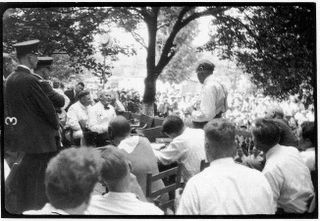
In 1925, Dayton, Tenn., high school teacher John Scopes was charged with teaching the theory of evolution. Doing so was a violation of a Tennessee law, passed that year, permitting only the teaching of "Divine Creation of man as taught in the Bible" in the state's public schools and universities. In an eight-day trial that dominated national headlines, Scopes was convicted and fined $100. This picture was taken on a day when the trial was moved outdoors because of the heat inside the courthouse and shows Clarence Darrow, Scopes lawyer and a famed defense attorney of his day, interrogating William Jennings Bryan, the prosecutor and three-time Democratic presidential nominee who led the antievolution movement in America. The Smithsonian Institute in their archives, about 60 previously unpublished photos from the Scopes trial. You can view these photos at: http://siarchives.si.edu/research/scopes.html. In 1927, the Tennessee Supreme Court upheld the Butler Act, the law that banned teaching evolution in public school. Tennessee repealed the Butler Act in 1967 and a year later the U. S. Supreme Court struck down an Arkansas antievolution law. A play based on the trial, "Inherit the Wind," opened on Broadway in 1955 and was adapted into a film in 1960. Posted by Picasa

THE SPEECH THAT'S WARRANTED THAT WILL NEVER BE MADE . . .

Have I made any mistakes? Yes, I started a terrible and completely unnecessary war. When we couldn't find any weapons of mass destruction, I then pretended the main mission was to spread democracy. I have not made us any safer. On the contrary, my actions have earned America the scorn of the world and created a vast new generation of terrorists. I regret putting over a million servicepeople in harm's way, with 1,700 dead and many thousands wounded so far. And as a Christian, I greatly mourn the continuing loss of innocent Iraqi lives, the total of which is several times greater than the number lost at the World Trade Center. In short, I am so very, very sorry. (written by Garry Trudeau for DOONESBURY)

THE "PINE TAR" HOME RUN


On July 24, 1983 the "pine tar" home run was hit by the Kansas City Royals' George Brett off New York pitcher Rich Gossage at Yankee Stadium. Brett's shot came with two out in the top of the ninth to give the Royals a 5-4 lead. Brett's homer was ruled an out because the amount of pine tar on the bat exceeded what was allowed. After a protest by the Royals, the decision was later overturned. Brett's homer counted, and the final out for the Royals and the Yankees' half of the ninth was completed on Aug. 18.  Posted by Picasa

Saturday, July 23, 2005

THERE'S NEVER BEEN ANOTHER LIKE HIM . . . LEROY "SATCHEL" PAIGE


In many respects Satchel Paige was to Negro League baseball what Babe Ruth was to the majors---a rare combination of talent and personality that captured the imagination of fans across America. Paige's unique brand of showmanship combined with his remarkable skills on the mound to fill ballparks everywhere and keep the fans coming through the turnstyles through even the darkest days of the Great Depression. The widely traveled Paige began his career with the Chattanooga Black Lookouts in the Negro Southern League in 1926. Later with the Pittsburgh Crawfords his legendary performances, which often included gawdy 30+ win seasons, established him firmly as black baseball's premier pitcher. Though records are incomplete, Paige is often credited with having recorded more than 300 career shutouts---not wins, SHUTOUTS! His career win total is estimated at well over 1500 games. In 1939 Paige began a nine-year stint with the Kansas City Monarchs. In this era of his long career he led the Monarchs to four consecutive Negro American League pennants and a Negro World Series championship in 1942. At the age of 42 Paige became the oldest rookie in major league history when he joined the Cleveland Indians during the 1948 pennant race. Joining the team late in the year Satchel posted a 6-1 record to help the Indians clinch the American League title. Joe Dimaggio said that Satchel Paige was the fastest and best pitcher he had ever seen. Posted by Picasa

A perfect match: Satchel Paige and the Hall of Fame Posted by Picasa

NEW WORLD ORDER FOR ART


The new Guggenheim Museum of New York will be twice as large as the one in Bilbao, Spain and will take four years to build. Frank Gehry's proposed design for the new museum has been given the go ahead by the city and resembles modern sculpture and the impossible dimensions of cyberspace. Its slithering, unfolding mass of glass, concrete and titanium, based on Gehry's highly acclaimed Bilbao Guggenheim in Spain, will sit on the East River, alongside the Financial District. But unlike Bilbao's curvaceous silhouette, the new building's baroque twists are as much sculpture as actual structure. Wrapped within this multitude of what looks like confusion lies a fairly traditional skyscraper, which Gehry has given a wrenching twist. This inner skyscraper reflects Gehry's vision of tying the new Guggenheim to the buildings around it. The tower is slated for luxury condominiums that will be sold or leased at a premium to corporate donors and wealthy patrons. An ice skating rink and a restaurant will sit underneath the structure. However, its implied audience is not the citizen, but the corporate, cosmopolitan elite. Whatever you may think of this, you have to give credit to Gehry, his museum wrapped around a skyscraper is the perfect embodiment of the New World order for Art. Posted by Picasa

The Gehry-designed Guggenheim in Bilbao, Spain, proved that if a new building is enough of a draw, it could revitalize a region as effectively as a comprehensive master plan. Posted by Picasa

Thursday, July 21, 2005

WHO SAID THAT ??

"Great spirits have always encountered violent opposition from mediocre minds." (scroll down)

This year marks the 50th anniversary of the death of Albert Einstein who made this astute observation. It has been 100 years since Einstein published his first major paper on the hypothesis of energy quanta and its theoretical implications. Posted by Picasa

IT'S ALMOST LIKE LOSING A MEMBER OF YOUR OWN FAMILY . . .


The TV show set inside a funeral home is about to bite the dust. After the last episode of HBO's deliciously dark "Six Feet Under" airs Aug. 21, the fictional Fisher clan will be gone. We will have lost a family we have come to know most intimately. There's repressed mother Ruth, conflicted sons Nate and David, angst-ridden and artsy daughter Claire. We've come to love each one, with all their flaws. Posted by Picasa

The Cast of "Six Feet Under" Posted by Picasa

The Fisher Family


In 2002 "Six Feet Under" led the way with 23 Emmy nominations. Posted by Picasa

Sunday, July 17, 2005

NEW BRIDGE SPANS OLD RECORD


Hundreds of people filled an eight-lane highway on Saturday to dedicate the $632-million Ravenel Bridge over the Cooper River, the longest cable-stayed span in North America. The bridge's 1,546-foot main span is supported by cables stretching down from the tops of a pair of diamond-shaped, 570-foot-tall towers. Unlike suspension bridges such as San Francisco's Golden Gate, where the deck is suspended beneath two hefty main cables that connect the towers in a lengthy curve, the Ravenel cables extend directly from the towers to the deck. The eight-lane bridge which serves as a connection between Charleston and Mount Pleasant, South Carolina took four years to build. The Ravenel's main span is 20 feet longer than the Alex Fraser Bridge in Vancouver, Canada, which had been the longest on the continent. Posted by Picasa

Monday, July 11, 2005

THAT WAS THEN AND THIS IS NOW


Major League Baseball has been doing the hokey pokey with pitchers and their sleight of hand for more than 100 years. The latest to be caught red-handed was Brendan Donnelly, the Angel reliever who was thrown out of a game for having pine tar on his glove. The Angels are asking whether or not pine tar should be illegal for pitchers. That invokes years of tradition. In yesteryears the spitball was a legal pitch through the 1919 season. Teams facing known spitball pitchers sometimes would apply manure to the ball to keep them from licking it. The last legal spitball pitcher was Burleigh Grimes of the Brooklyn Dodgers who retired after the 1934 season, but the spitball has never really gone away. Pine tar, or mud, or scuff marks or anything that alters the smooth surface of the ball, including the stitches, reduces drag the way dimples reduce drag on a golf ball. Posted by Picasa

Tuesday, July 05, 2005

HOW MANY HOT DOGS CAN YOU EAT ??


Takeru Kobayashi captured the Nathan's Famous hot dog eating contest on Coney Island, gobbling 49 hot dogs in 12 minutes. He was a little short of the world record of 53 1/2 hot dogs, which he set last year at the Fourth of July competition. Kobayashi, of Nagano, Japan, weighs 144 pounds and is 27 years old. The runner-up ate 37 hot dogs. Posted by Picasa