Monday, January 12, 2009

“They are in fact going to be doing chin-ups on the bottom tier of presidents in modern history" -- Cal Jillson, SMU professor


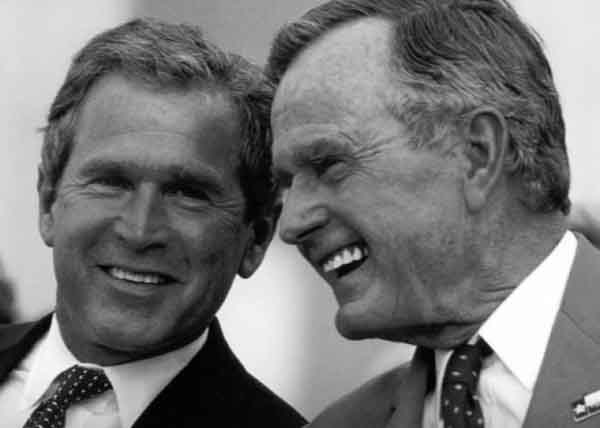
George W. Bush came to office in effect seeking to be the anti-Bush — the opposite of his father. He would use his political capital. He would win over conservatives. And he would have a happier political ending. But in the end his presidency in some ways parallels his dad’s: Both Bushes saw extreme highs in public opinion. The first President Bush won accolades for his handling of the Gulf War in 1990, forcing Iraq out of Kuwait. The second President Bush calmed a frightened nation in the aftermath of the Sept. 11 attacks, taking up a bullhorn to promise that the world would soon hear America.

And both saw their presidencies swamped by a sea of public dismay. The elder Bush was castigated for being out of touch as the economy foundered and he seemed unable to relate. The younger Bush was pilloried for his handling of the wars in Iraq and Afghanistan. Later he was criticized for an ideological rigidity that delayed early, forceful intervention as the economy careened into a ditch far deeper than his father’s.

As George W. Bush prepares to return to Texas, historians will be judging his legacy in the context of his father’s single term as president.

“The likelihood is that the father will be looked upon as a steadier hand and better prepared for the job,” said Bruce Buchanan, a professor of government at the University of Texas who specializes in the presidency.

Cal Jillson, a political science professor at Southern Methodist University, calls the senior Bush “dramatically more accomplished” in both foreign and domestic policy than his son. Still, he said, “They are in fact going to be doing chin-ups on the bottom tier of presidents in modern history.”

Sunday, January 11, 2009

They say "change" is coming

Washington is abuzz as preparations for Obama's inaugeration, including a White House-adjacent reviewing stand, swing into high gear.
(Ron Edmonds / Associated Press)

"Citizen Soldier"--Captain Harry S. Truman

Harry Truman became a charter member of the newly formed Battery B of the Missouri National Guard on June 14, 1905 where he served as battery clerk and was discharged a corporal in 1906. But with the United States declaration of war on Germany, he reenlisted in the Missouri National Guard, where he was elected first lieutenant at the age of 33 in the 2nd Missouri Field Artillery. On August 5, 1917 his unit was sworn into the Regular Army as the 129th Field Artillery on the 35th Division. He was given command of Battery D on July 11, 1918 in Brittany. Captain Truman developed his battery into a topnotch combat unit. At the end of a month the battery was setting regitmental records for firing accuracy and speed in disassembling, moving and setting up the guns for firing. Truman had won the unit's respect and admiration as well. Truman's concern and respect for his unit can be summed up with his own comment, "I want to tell you this, too, fellows. Right now, I'm where I want to be-in command of this battery. I'd rather be here than president of the United States." Harry S. Truman was discharged from the U.S. Army as a captain in 1919. He became 33rd president of the United States of America in 1945. His World War I service stood him in good stead as he realized the critical importance of capable and competent leadership and the value of team work. Today the 129th Field Artillery maintains a Battery D "Truman's Battery"--the only Battery D in the National Guard--in his honor.

Chrysler (again) works to design itself a miracle

Chrysler today unveils the Circuit, a pure electric vehicle based on the British sports car Lotus Europa.

Helen Hunt Jackson's 1884 novel "Ramona"

“Ramona” has been made into films several times, including a Technicolor version in 1936 that starred Loretta Young and Don Ameche as the young lovers.
(20th Century Fox)

Helping to keep the Ramona name alive in 1928 was another cinematic telling of the Southern California-set story. This time, it starred Dolores del Rio.
(United Artists)

"gnarled branches reaching skyward"

This California black walnut tree is so enormous and old — it was planted in 1870 or so — that it needs propping up these days. Visit the tree at Ranch Camulos and you can marvel at the gnarled branches reaching skyward like tentacles from the Earth.
(Christopher Reynolds / Los Angeles Times)

When Feathers Flew

Fred Astaire and Ginger Rogers danced together in 10 magical movie musicals, including nine at RKO from 1933 through 1938. Sixty years after they last appeared together on screen, their collaboration that has held up the best, according to most cineastes and critics, is "Top Hat" (1935), which -- like four of the others -- was directed by Mark Sandrich.


The film is best known and most commonly referenced ("The Purple Rose of Cairo," "The English Patient," "The Green Mile") for a song-and-dance number that pops up about halfway through, "Cheek to Cheek," which remains one of the most charming, romantic, and crowd-pleasing sequences ever committed to celluloid. For the participants, though, it was one of the most tedious and least enjoyable they ever endured -- and all because of a dress!

Bernard Newman, head costume designer for RKO, welcomed actors' suggestions for costumes. Rogers, then 24, took him up on his offer by requesting an item about which she had obviously fantasized: a pure blue dress -- "like the blue you find in paintings of Monet" -- festooned "with myriads of ostrich feathers." In record time, he produced a beautiful creation that fit that very description, and was additionally notable for its high neck and low back. Sandrich, Astaire, and the "Top Hat" crew got their first look at it -- and felt their first concerns about it -- as it was being delivered to Rogers' dressing room on the set, leaving in its wake a trail of feathers.

Sandrich assumed the thankless task of pointing this out to Rogers, who could be a bit of a diva. When he did, he also suggested that she instead wear the "much, much prettier" white dress she had worn in the "Night and Day" number of "The Gay Divorcee" (1934), her last picture, which he had brought down from storage to give to her. Rogers was appalled by the notion of reusing a dress she had previously worn in another film, insisting that moviegoers would remember it, and grew even more upset after five members of RKO's front office got involved in the matter -- and Astaire did not.

The situation escalated after she summoned her mother, Lela Rogers -- an archetypal stage mother if ever there was one -- to the studio. Before long, the Rogerses ended the discussion and walked off the set in protest. They were convinced to return only after Sandrich reluctantly agreed to shoot the scene with Rogers in the feather dress, inspect how it came across the rushes the next day, and only then decide whether or not it had to go.

"Everything went well through the song," Astaire remembered years later, "but when we did the first movement of the dance, feathers started to fly as if a chicken had been attacked by a coyote... They were floating around like millions of moths," and sticking to his skin and clothes. Choreographer Hermes Pan recalled, "They blinded Fred, and got in his nose, and made him sneeze."

"This went on until the cameraman stopped the scene," Astaire said, "because he couldn't photograph the number that way, and also that the floor was covered with feathers. It got to be funny after a while. The news went all over the lot that there was a blizzard on the 'Top Hat' set."

By one account, as many as 60 takes were attempted, each impeded by the constantly thinning dress. As efforts dragged on late into the night, and then much of the next day, the wardrobe department was kept busy trying to reinforce each individual feather. "Finally," Astaire recalled, "the fallout had run its main course. With just a minimum amount flying, the cameraman decided he would take a chance and photograph the number." In the rushes that ran the next day, a few stray feathers could still be seen drifting off the dress, but it wasn't a big deal and the scenes were deemed acceptable.


In some respects, the relationship between Astaire and Rogers would never be the same. After the scene was finally captured, Astaire and Pan tried to make light of it by singing "a little parody" of "Cheek to Cheek" to Rogers. It went, "Feathers, I hate feathers/And I hate them so that I can hardly speak/And I never find the happiness I seek/With those chicken feathers dancing/Cheek to Cheek." Rogers didn't find it funny. A few days later, though, Astaire more than made amends when he had a small white box delivered to her dressing room that contained a gold feather to add to her charm bracelet along with a note that read, "Dear Feathers, I love ya! Fred."

All's well that ends well, I guess: After "Top Hat," Astaire and Rogers would work together -- happily, for the most part -- on six more films. Astaire would later parody the dress disaster, with the aid of Judy Garland, in "Easter Parade" (1948). Rogers would forever after go by the nickname "Feathers." And as for the feather dress itself? It currently resides at the Smithsonian and has outlasted everyone who worked on the film for which it was crafted.

Who are the Watchmen?

Take the outlawed superhero community of Pixar’s “The Incredibles,” drop it into a multi-generational tribal tale like “ The Godfather II” and add a trippy riff on “Forrest Gump’s” at-the-elbow-of-history plot device (one character parties at Studio 54 with Jagger and Bowie, another pulls the trigger the day JFK died in Dallas), and you start to get a feel for “Watchmen,” due in March. Here’s a look at some of the key characters:
The Comedian (Jeffrey Dean Morgan): He’s comedic in the same way the Joker is funny; a thuggish killing machine, this “hero” is the ultimate fixer for American black-ops at home and abroad. His murder is the mystery at the heart of the story.
Rorschach (Jackie Earle Haley) The inscrutable masked loner was a product of a vicious upbringing (he shed no tears when his prostitute mother was murdered by her pimp) and sees the world in absolutes of black and white, which is why he alone is on a mission to solve the slaying of the unpopular Comedian.
Nite Owl II (Patrick Wilson): His gadgets recall a certain Gotham City resident, but this caped hero, pulled back from a pudgy retirement, is meek without his costume and, in another first for superhero cinema, has sexual dysfunction issues.

"a folk hero to much of the downtrodden public"

Johnny Depp stars as legendary Depression-era bank robber John Dillinger, who became the No. 1 target of J. Edgar Hoover’s fledgling FBI and a folk hero to much of the downtrodden public. With Christian Bale, Marion Cotillard, Giovanni Ribisi, Billy Crudup. Directed by Michael Mann. Written by Mann, Ronan Bennett, Ann Biderman and Mark St. Germain. Universal, coming to a theatre near you July 1.

Tuesday, January 06, 2009

The once-proud steamship------------------------ SS Catalina------------------

Built at a cost of $1 million by onetime Catalina Island owner and chewing gum mogul William Wrigley, the SS Catalina plied the ocean between Wilmington and Avalon daily between 1924 and 1975.

Along with a 26-mile ocean voyage, a $2.25 round-trip ticket offered 2,200 passengers big-band orchestra music for dancing, children's entertainment by clowns and magicians, and adult amenities such as a leather settees and drinks from a shipboard bar.

Smaller, faster ferries connecting the mainland and the island eventually spelled doom for the huge steamship, known for its crisp white paint job and deep, melodious horn that announced its departure.

Its arrival in Avalon would be heralded by circling speedboats. Children would dive into the water for coins tossed over the rail by passengers as island townspeople sang to passengers walking down the 25-foot gangplanks.

In the end, the Great White Steamer was a great white elephant. The once-proud steamship, which ferried millions of passengers to the island town of Avalon, is being cut for scrap after sitting for years abandoned in Ensenada harbor.


"some of the world's richest diversity of corals"

President Bush will create three national monuments in the Pacific Ocean today, protecting waters near U.S.-controlled islands that contain some of the world's richest diversity of corals, fish and other sea life as well as unusual geological formations in the deepest undersea trench.

Jarvis Island, where blue plate coral thrive, is part of the national marine monuments being created by President Bush and is home to Jarvis Island National Wildlife Refuge. Shallow reefs surround the island, but a broad submerged reef terrace extends off the eastern shore. Live coral covers about 50 percent of the reef terrace, and about 50 species of corals have been reported at Jarvis, according to the U.S. Fish and Wildlife Service.

A researcher counts fish near a coral reef at Palmyra Atoll, south of the Hawaiian Islands. The monument designations will ban most commercial fishing and will vastly limit recreational fishing, or fishing by indigenous people or researchers. In all of the protected areas, seafloor mining will be prohibited

Monday, January 05, 2009

Water is all that is left behind

The most distinctive feature of the Honda FCX Clarity—other than the fuel cell itself—is the streamlined layout made possible by its compact and efficient powertrain components.

The fuel cell combines hydrogen with oxygen to make electricity. The electricity then powers the electric motor, which in turn propels the vehicle. Water is the only byproduct the FCX Clarity leaves behind.

"San Luis Rey"

San Luis Rey, oil on board, 30 x 46 inches by Charles H. Harmon (1859-1936)

India: "intoxicated by the sights"

The sculpture-laden gopuras (towers) of the Meenakshi-Sundaresvara Temple in Madurai, Tamil Nadu

Back on Broadway

Stockard Channing, the 64-year-old Tony and Emmy winner is singing on Broadway for the first time since 1984. Channing has four songs in the update of the Richard Rogers-Lorenz Hart musical "Pal Joey," including the stunning "Bewitched, Bothered and Bewildered."

Set in Chicago in the late 1930s, "Pal Joey" tells the story of a venal song-and-dance man who is romancing two women: a wholesome girl and a wealthy, married older woman, Vera Simpson, played by Channing.


"Jack London in Paradise"

Since Jack London's mysterious death in 1916, he has been, like one of the frozen men in his Klondike tales, a writer encased in his own reputation: We know him as the dog writer. Whether it was Buck in "The Call of the Wild," coming to terms with his inner-wolf, or the husky in "To Build a Fire," edging out his master in a Darwinian struggle against the cold, London could lock our emotions onto canines without making it feel like a sentimental exercise.

London was a man of contradictions. Born in San Francisco in 1876, he was raised partly by a former slave, though he later bought into scientific racism. Jack London rushed for gold in the Yukon. He found none but made a fortune mining his experience for stories, becoming one of the first American writers to live solely off his prose. Paul Malmont's new novel, "Jack London in Paradise," fictionalizes London's late-in-life entanglements with Hollywood and films while creating a rich characterization of a "bigger than life" writer who has become a legend.

Sunday, January 04, 2009

"At Rainbow's End"

Ted and Marlyn Lawson of Palos Verdes were on a 14-day Africa tour when Ted caught this shot of Victoria Falls, between Zambia and Zimbabwe. He used a Minolta 600SL-AF24-85. The cascades, originally dubbed "Tthe Smoke That Thunders" by local tribes, were re-tagged by explorer David Livingston in 1855 in honor of Queen Victoria.
(Marlyn Lawson)

"How dey do dat ??"

Photo taken and shared from the incredible ice sculptures submitted at the Fairbanks Ice Festival, Fairbanks , Alaska !

"Stormy Tower"


Stormy Tower by Shweta

"It was a dark and windy afternoon when I took this photo from a boat on the Seine. The shot was definitely worth me almost dropping my slippery camera into the water."

"Blue Eiffel Tower"

Blue Eiffel Tower by GdG

The Eiffel tower dressed in blue, the color of the European Union's flag. This image lasted until the end of 2008 when France's EU's presidency ended. The tower twinkled every hr. on the hr.